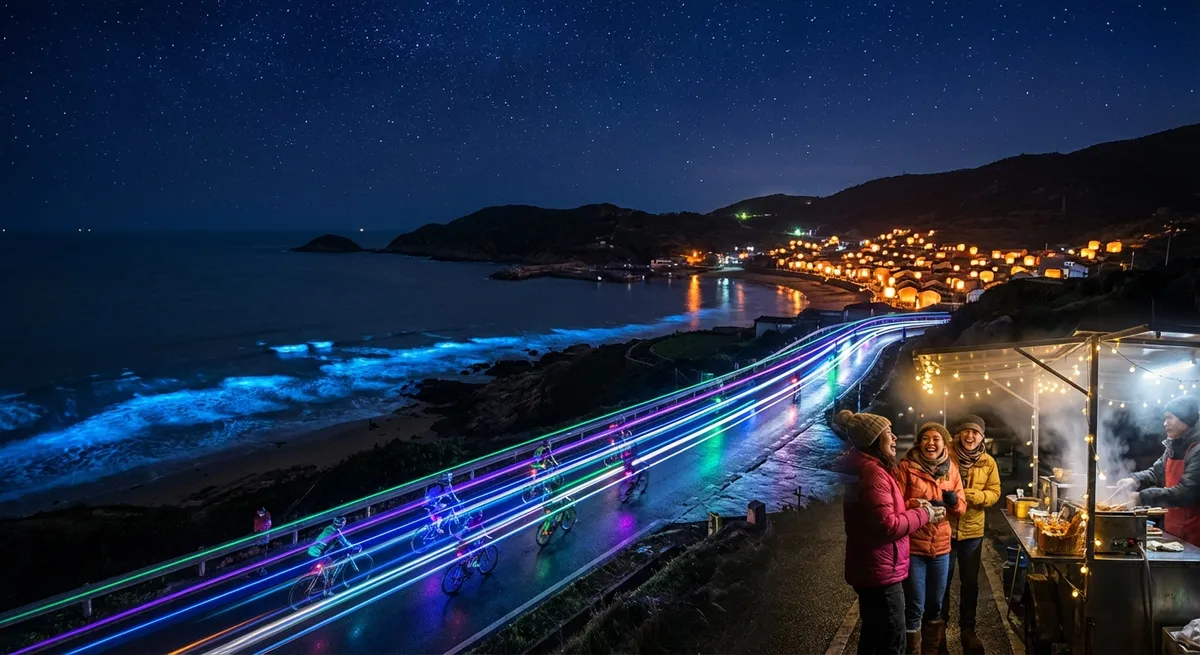
Below are five night-powered experiences that turn “bedtime” into the beginning of the story—each one a call to step outside, look up, and let the night rewrite what you thought travel could be.
1. Cities That Never Sleep: Skyline Nights in Hong Kong
Hong Kong by day is dense, loud, and dizzying. After dark, it becomes an electric canyon of glass and neon, with Victoria Harbour reflecting a skyline that feels like it’s still being built as you watch. This is a destination where sunset should be your starting gun, not your finish line.
Ride the Star Ferry after dusk and watch the skyscrapers ignite in color. Take the Peak Tram up to Victoria Peak for a panoramic view where headlights trace the roads like glowing threads. Duck into night markets in Mong Kok, where steam rises from street food stalls and you can try egg waffles, fish balls, and milk tea between rows of glowing shop signs.
Practical move: Pack a light jacket—the harbor breeze can surprise you—and carry a small tripod or use railings for low-light shots. Study the metro map before you head out; trains run late, but not forever.
The real secret? Don’t chase just the famous viewpoints. Wander down side streets in Sheung Wan or Sai Ying Pun, where steep staircases cut between old buildings and tiny bars and noodle shops hum with locals finishing their day. In Hong Kong, the night is not an afterthought—it’s the main event.
2. Northern Skies on Fire: Chasing the Aurora in Arctic Circles
Some destinations promise you views. The Arctic Circle promises you a sky that moves. Under the right cold, clear night, the aurora borealis doesn’t just appear—it performs, rippling in ribbons of green, purple, and white that make every photo look like an editing trick.
In places like Tromsø (Norway), Abisko (Sweden), and Fairbanks (Alaska), the night sky becomes your itinerary. You’ll suit up in insulated layers, step out into air that bites your lungs, and watch as the stars blur behind curtains of color. It’s the kind of sight that makes people whisper without meaning to, as if they’ve stumbled into a cathedral built of atmosphere and solar wind.
Practical move: Aim for aurora seasons—typically late fall to early spring—and check cloud forecasts as carefully as aurora forecasts. Book at least a few nights; the lights are wild, not scheduled, and patience is your best gear. If possible, step away from city glow to find true darkness.
One underrated joy: the aftermath. Returning to a warm cabin, thawing out by a fire, replaying the sky you just saw while hot chocolate warms your hands. The aurora is only part of the destination; the stillness, silence, and sense of being at the edge of the map is the rest of the story.
3. Bioluminescent Shores: Walking Through Living Starlight
In rare pockets of the world, the ocean glows when you touch it. Bioluminescent bays and beaches transform a simple shoreline into something alien and hypnotic: waves that flash electric blue, footprints that sparkle, paddles that leave comet trails in the water.
Places like Mosquito Bay in Vieques, Puerto Rico, and bioluminescent lagoons in Jamaica and the Maldives turn a night swim into an otherworldly encounter. Tiny organisms called dinoflagellates light up when disturbed, so each stroke of your hand, each movement of your kayak, paints luminous streaks across the dark water. You’re not just watching the night—you’re drawing on it.
Practical move: Go on moonless or near-moonless nights for the strongest effect; bright moonlight can wash out the glow. Skip sunscreen and perfume before entering the water to protect fragile ecosystems, and choose operators who prioritize environmental protection.
The memory that sticks isn’t only the glow—it’s the hush. Boats drift with voices lowered. People who thought they’d just “check it out” end up dangling hands in the water in reverent silence. On these shores, the brightest thing in sight isn’t a building, a car, or a billboard. It’s the ocean itself, alive and answering your touch.
4. Desert Nights: Stars, Silence, and Infinite Horizons
Deserts are brutally honest by day. By night, they’re generous. When the heat drops and the wind softens, places like Wadi Rum in Jordan, the Atacama in Chile, or the Sahara in Morocco open up into a dome of stars that can reset your sense of scale in a single glance.
Camp out under canvas or straight beneath the sky. Sands that burned your feet at noon turn cool and powder-soft. You sit around a low fire, sharing stories with guides who know the terrain by heart, and eventually someone turns off the last lantern. The dark arrives fast—and then you see it isn’t dark at all. The Milky Way cuts across the sky like spilled light, and constellations you’ve only seen in diagrams feel close enough to lean against.
Practical move: Pack layers; deserts swing from scorching to cold quickly. Bring a headlamp with a red-light mode to preserve your night vision for stargazing. If you’re into photography, research night-sky settings beforehand—out here, the stars show up in full detail.
Desert nights are for slowing down. There’s no honk of traffic, no endless buzz, just the low murmur of conversation until even that fades. You realize how rarely you’ve heard real silence. You realize how much you’ve missed it.
5. Night Streets and Hidden Corners: After-Hours Soul of Old Cities
Some cities shed their daytime crowds like a skin when the sun dips. In places like Kyoto, Lisbon, or Seville, the most powerful moments are often the quiet ones—when narrow streets, historic alleys, and ancient squares belong to the soft glow of lanterns and street lamps.
In Kyoto’s Gion, you might drift past wooden machiya houses, the sound of distant shamisen floating through open windows. In Lisbon, alleyways twist down toward the Tagus River, with melancholic fado music spilling out of tucked-away taverns. In Seville, orange trees line plazas where locals linger in the blue hour, and cathedral spires glow like embers against the sky.
Practical move: Take a daytime walk first so you’re familiar with the layout. Then return after dark and let yourself get a little lost within a defined area. Look for local performances, late-opening cafés, and neighborhood bars where menus aren’t translated into ten languages.
The magic here is subtle but deep. The same streets you hurried through under the sun slow down at night. You notice details—the texture of stone walls, the rhythm of footsteps on cobblestones, the way light pools around doorways. You’re not just sightseeing anymore. You’re absorbing.
Conclusion
Destinations aren’t defined by latitude and longitude—they’re defined by the versions of themselves they reveal when the world expects you to sleep. The night is when skylines glow, oceans spark, deserts whisper, and old cities finally exhale.
The next time you plan a trip, don’t just search for “things to do.” Ask what a place becomes after dark. Leave room in your itinerary for late ferries, silent dunes, glowing bays, and midnight streets. Some of your most vivid memories won’t be the sunlit snapshots. They’ll be the moments when you stepped outside at night, looked up, and felt the whole world quietly humming, just for you.
Sources
- Hong Kong Tourism Board – Night Experiences – Official overview of nighttime views, harborfront, and evening attractions in Hong Kong
- Norwegian Meteorological Institute – Aurora Forecast – Up-to-date information and forecasts for viewing the northern lights in Norway and other Arctic regions
- U.S. National Park Service – Bioluminescence – Scientific explanation of bioluminescent organisms and where they appear in marine environments
- European Southern Observatory – Atacama Desert Skies – Details on why the Atacama Desert offers some of the best stargazing conditions on Earth
- Japan National Tourism Organization – Kyoto Night Walks – Information on evening ambiance, historic districts, and nighttime experiences in Kyoto