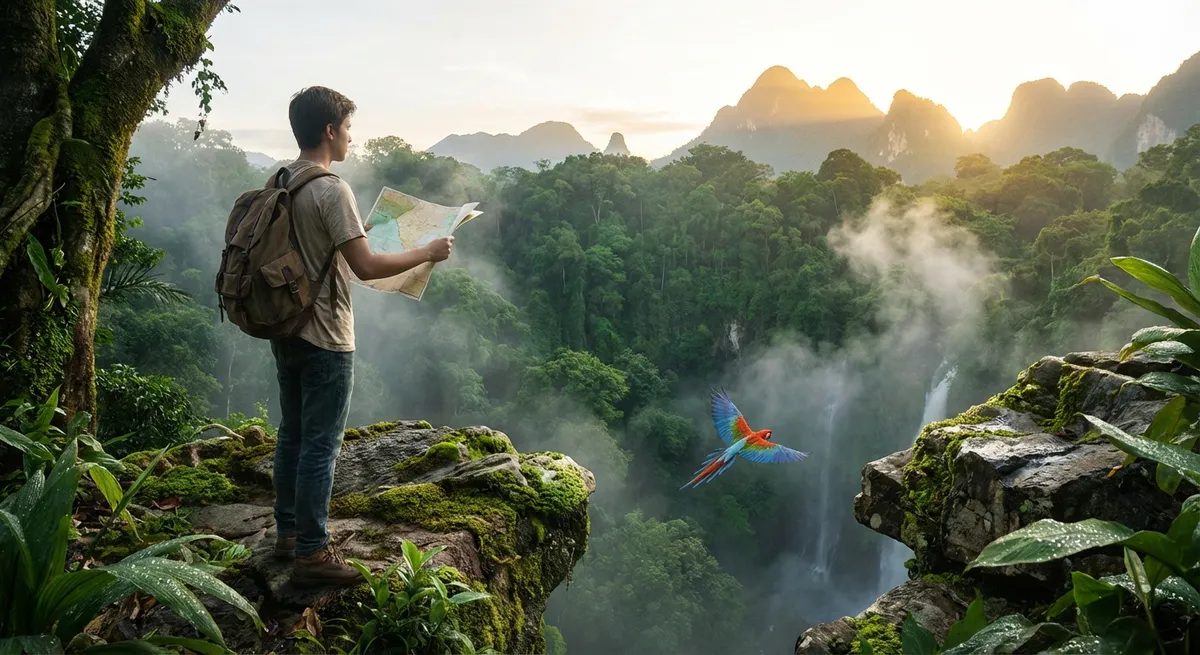
Below are five destination ideas, each with a different kind of thrill. Use them as sparks, not a script. Adapt them, remix them, and let them push you toward your own version of “next.”
1. Volcano Coastlines Where the Earth Feels Alive
There are places where the planet doesn’t sit still—it breathes, rumbles, and glows. Volcano coastlines strip travel of its filters and remind you that you’re walking on a living world.
Think of Hawaiʻi’s Big Island, where black lava fields run into turquoise water and, in Volcanoes National Park, steam vents whisper from the earth. Or Iceland’s Reykjanes Peninsula, where geothermal fields hiss and the ground is painted in rust, lime, and ash. Stand at the edge of cooled lava, and you’re literally stepping on yesterday’s fire.
To experience this kind of destination fully, plan around the elements. Check volcano activity updates, respect restricted zones, and book local guides who know the land’s moods. Pack layers—these places flip from hot to cold quickly—and give yourself time at sunrise or sunset when the light pulls out every jagged line of the landscape.
The real magic isn’t just seeing lava or hot springs. It’s the moment you realize the ground beneath you isn’t just “ground”—it’s motion paused in time, and you’re a tiny visitor on its surface.
Captivating point: You can walk on land that didn’t exist in your parents’ lifetime—and may not look the same for your kids.
2. High-Altitude Cities That Teach You a New Pace
High-altitude destinations are less about racing around and more about learning how to move differently through a day. The air is thinner, the light is sharper, and even walking up a hill can feel like a quiet negotiation with your lungs.
Picture La Paz in Bolivia, a city cradled in a canyon at over 3,500 meters, its cable cars gliding above neighborhoods like slow, silent comets. Or Cusco in Peru, once the capital of the Incan Empire, where cobbled streets and Andean peaks share the same horizon. These cities demand patience: slower steps, deeper breaths, longer pauses to just…look.
Acclimatization is as much a part of the experience as the sights. Plan your first two days light—short walks, plenty of water, minimal alcohol, and early nights. Use that slower rhythm to sit in plazas, watch street life, taste local food, and feel the altitude not as an obstacle, but as a filter that keeps only the essentials: you, the mountains, and the moment.
Captivating point: Every breath becomes part of the journey—and the thinner air makes every view feel twice as earned.
3. Night-Shift Cities Where the Dark Comes Alive
Some destinations don’t wake up until the sun goes down. Neon reflects in puddles, markets unfurl under hanging lights, and the soundtrack switches from traffic to street musicians, sizzling food stalls, and late-night conversations.
Think of Tokyo’s Shinjuku or Shibuya, where layered signs and screens turn streets into electric canyons. Or Mexico City’s Roma and Condesa neighborhoods, where tree-lined avenues glow from café windows and people wander from taquería to mezcal bar with no rush to call it a night. In these places, darkness doesn’t mean “end of day”—it means “chapter two.”
To really experience a night-shift city, plan one evening with no fixed schedule. Start with food—night markets, street vendors, hole-in-the-wall spots the locals line up for. Then walk. Let your route be guided by sound or smell instead of a map: the beat from a side street, the scent of grilled skewers, the murmur of a crowd.
Stay alert and smart—stick to well-lit areas, use trusted transport options, and let someone know your rough plan. But don’t rush back to your room. Many cities reveal their truest personality between 9 p.m. and 1 a.m., and you’ll never see it if you treat night as downtime instead of destination.
Captivating point: Entire worlds exist between sunset and sunrise that day-trippers never even know are there.
4. Desert Horizons That Reset Your Inner Clock
Deserts look empty at first glance—but spend a little time, and you’ll realize they’re full of scale. Huge skies. Endless distances. Silence so deep you can almost hear your own thoughts settling.
Imagine the Sahara spreading out beyond dunes in Morocco, or the red-rock deserts of Wadi Rum in Jordan, where sandstone cliffs tower over wide-open valleys. Sunset doesn’t just dip behind buildings—it washes the entire world in orange and violet, then hands the sky over to millions of bright, unrushed stars.
Traveling in desert regions is all about timing and respect. Plan activity-heavy moments (like hikes or camel rides) for early morning or late afternoon to dodge the harshest sun. Hydrate constantly, wear breathable clothing that covers your skin, and listen to local guides—they understand how quickly these landscapes can turn from thrilling to unforgiving.
The reward? Long stretches of pure quiet, campfires under impossible skies, and the grounding realization that you’re just a small figure moving through a very ancient story.
Captivating point: With no city noise or screens to distract you, you can literally hear the rhythm of your own curiosity again.
5. Water-World Destinations Where Roads Don’t Matter
Some places don’t measure distance in miles—they measure it in currents and crossings. In water-centric destinations, your days are planned around tides, ferries, kayaks, and the simple question: “How do we get across?”
Picture Indonesia’s island chains, where boats are as common as buses. Or the Norwegian fjords, where villages cling to cliffs and ferries link communities across glassy, mountain-framed waters. In these places, you stop thinking in straight lines and start thinking in routes that curve, meander, and float.
Practical prep matters here. Research local ferry schedules well in advance, especially in off-season months when routes can be limited. Pack dry bags for electronics, a quick-dry towel, and shoes that can handle wet docks and rocky shorelines. Choose at least one day to travel the “slow way”—by kayak, paddleboard, or traditional boat—where getting there is the entire point.
On the water, time stretches. Distances feel different. You start watching clouds, wind, and waves the way you might normally check your phone. And when you finally dock somewhere new, stepping onto land feels like arriving on another planet—even if you’re just one bay over.
Captivating point: When the route is all water, every crossing feels like a mini-expedition, not just transportation.
Conclusion
Destinations that stay with you don’t just show you something new—they wake up something dormant inside you. A volcano coast that reminds you the world is alive. A high-altitude city that slows your stride and sharpens your gaze. A night-lit neighborhood that teaches you to trust the dark. A desert that resets your pace. A water-world where roads vanish and possibilities expand.
You don’t need to chase them all at once. Choose one kind of wild and lean into it. Let the landscape dictate your tempo, your routes, even your questions. Because when you travel this way, you’re not just collecting places—you’re rewriting how you move through the world.
Your next “hop” doesn’t have to be bigger. It just has to be braver.
Sources
- US National Park Service – Hawaiʻi Volcanoes National Park – Official information on volcanic landscapes, safety guidance, and visitor planning
- Icelandic Meteorological Office – Volcanic Activity – Up-to-date data and maps on volcanic and geothermal activity in Iceland
- Centers for Disease Control and Prevention – Travel to High Altitudes – Evidence-based advice on acclimatization, altitude sickness, and health precautions
- Royal Geographical Society – Deserts: Landscapes and Ecosystems – Educational overview of desert environments and their unique challenges
- Norwegian Public Roads Administration – Ferry Connections – Official information on Norway’s ferry network across fjords and coastal regions