This guide isn’t about “must‑see” lists or overdone hotspots. It’s about places where the atmosphere hits differently, where your senses are shaken awake—through light, sound, taste, and the raw energy of the landscape. Ready to follow the tingling in your fingertips instead of the brochure?
1. Cities That Never Sleep, They Vibrate: Tokyo, Mexico City & Beyond
Some cities don’t just buzz—they roar gently, all the time. Tokyo and Mexico City are two places where the pace is relentless, but the magic is in letting the current carry you instead of fighting it.
In Tokyo, neon reflections spill across wet streets in Shinjuku, vending machines glow like tiny altars on quiet corners, and late-night ramen counters steam up your glasses while slurping becomes a shared language. Neighborhoods shift moods like scenes: serene Meiji Shrine one minute, pulsing Shibuya Crossing the next. The key is to walk until your legs hum, let your internal clock break, and lean into the 24-hour rhythm: convenience stores at 3 a.m., sunrise from a quiet side street, and the sleepy calm of early-morning trains.
Mexico City wraps its energy around you differently. Here, sound is the current: street vendors calling out, cumbia spilling from doorways, car horns creating a strange kind of improvised music. Step into a leafy plaza in Roma Norte or Condesa, and you’ll feel the city breathe. Visit a bustling market for the smell of roasted corn and fresh tortillas, then slip into a museum courtyard for cool stone and silence. Adventure here means saying yes—to a taco stand with no English sign, to a late-night mezcal bar, to a last-minute Lucha Libre match.
Practical move: In big, electric cities, pick one or two “anchors” (a local cafe, a park, a neighborhood bar) and return to them over a few days. You’ll watch the energy shift by hour—and suddenly, you’re not just visiting; you’re part of the current.
2. Landscapes That Feel Like Another Planet: Iceland, Atacama & the Edges of Earth
Some destinations make you question what planet you’re on. They’re not just photogenic; they’re disorienting in the best way, forcing you to recalibrate what “normal” nature looks like.
Iceland is an entire mood swing of a country: black sand beaches where waves slam the shore like a drumbeat, moss-covered lava fields glowing neon green, waterfalls that roar so loudly you feel the sound in your ribs. Drive a few hours and it’s like you’ve switched worlds—glaciers one morning, steamy geothermal pools by afternoon, midnight sun or winter darkness reshaping your sense of time. The terrain doesn’t ask you to admire it; it dares you to keep up.
Then there’s Chile’s Atacama Desert, one of the driest places on Earth, where the air is so clear the stars look close enough to touch. Hike through Valle de la Luna (Valley of the Moon) and you’ll see why it’s named that—otherworldly rock formations, salt flats that shimmer in distorted heat, colors shifting from copper to violet at sunset. Stay after dark and the Milky Way will spill across the sky in a way that makes city lights feel like a faint memory.
Practical move: In extreme landscapes, give yourself full “sense days.” One day for sound (waterfalls, wind, silence), one day for sky (sunrise, noon, dusk, stars), one day for texture (sand, rock, ice, moss). You’ll remember the trip not as a checklist of sights, but as a series of physical sensations your body won’t forget.
3. Ports Where the World Converges: Lisbon, Istanbul & the Edge of Two Worlds
Port cities are natural crossroads—places where histories, languages, and flavors have been mixing for centuries. The air tastes faintly of salt and possibility, and the streets feel like stories layered on top of each other.
Lisbon is a city that creaks and gleams at the same time. Tram cables crisscross the sky, tiles flicker in the sun like scales on an old dragon, and the Atlantic wind whistles up the hills. You’ll hear fado music spilling out of tiny taverns—haunting songs of longing that make you feel nostalgic for places you haven’t even left yet. Stand at the Miradouro da Senhora do Monte at golden hour and watch the Tagus River glow; it’s impossible not to feel like you’re standing on the threshold of somewhere new.
Istanbul takes the idea of a crossroads and turns it into a full-body experience. One ferry ride and you’re crossing from Europe to Asia as gulls trace arcs overhead. The call to prayer drifts over rooftops, spices from the bazaars tighten your throat with their intensity, and every cup of tea feels like a quiet pause in a city that’s been moving for thousands of years. You’re not just between continents; you’re between eras.
Practical move: In port cities, travel by water at least once—ferry, river cruise, harbor boat. Seeing the city from its waterline gives you instant orientation: where trade came from, where invasions arrived, where stories began. It changes how every street feels when you’re back on land.
4. Night Skies That Reboot Your Sense of Scale: Lapland, New Zealand & Dark Sky Sanctuaries
Some destinations flip your perspective not horizontally, but vertically. Instead of horizon chasing, you’re sky chasing—and what you see above you can rearrange your sense of scale completely.
In Finnish or Swedish Lapland, the nights can feel endless in winter, but that darkness is a canvas. Step away from town lights, and you’re wrapped in a silence so complete you can hear snow compress under your boots. Then, if the conditions line up, the northern lights appear—not as a static postcard image, but as living color: ribbons of green and violet shifting, pulsing, vanishing, then exploding again across the sky. It’s less like watching a show and more like witnessing the planet breathe.
On the other side of the world, New Zealand’s Aoraki Mackenzie International Dark Sky Reserve offers a southern-hemisphere version of the same awe. With strict light pollution controls, the night is so deep that the Milky Way arches overhead like a river of crushed diamonds. Shooting stars become frequent visitors, and constellations you’ve never seen from your home latitude feel like a secret only the southern sky is sharing with you.
Practical move: Plan one entire evening around the sky. No early wake-up the next day, no tight schedule. Layer up, bring something warm to drink, and stay out longer than feels “reasonable.” The most unforgettable displays often arrive after most people have already gone back inside.
5. Cities You Taste Before You Understand: Bangkok, Marrakech & Flavor-Driven Travel
Some destinations introduce themselves through your taste buds first, and everything else—history, culture, rhythm—unfolds from there. If you love the idea of eating your way through a city, these places aren’t just delicious; they’re transformative.
Bangkok is a full-sensory storm, but food is its compass. Your day might start with sweet, icy Thai tea; by midday, you’re sweating happily over a bowl of tom yum, and at night, you’re perched on a plastic stool at a street stall, watching woks blaze while the city’s traffic hums around you. The air is a collision of chili, lemongrass, grilled meats, and exhaust. Follow the longest lines, not the fanciest signs—locals know exactly where flavor lives.
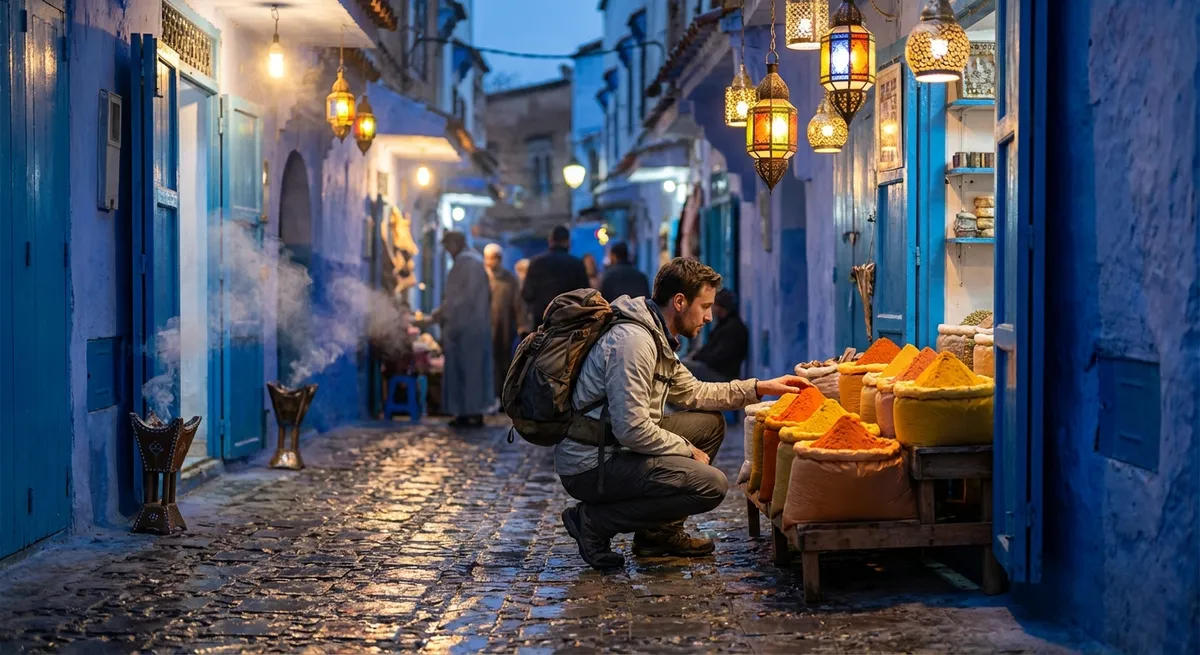
Marrakech wraps you in scent before you even step into the markets: cumin, saffron, fresh mint, tangled with the smoke from street food stalls in Jemaa el-Fnaa square. Tagines simmer slowly in clay pots, oranges are pressed into juice right in front of you, and mint tea is poured from high above the glass, turning something simple into a small ceremony. Wander the medina and you’ll find that every turn offers another bite, another smell, another reason to linger.
Practical move: Dedicate one day in a “food city” to a self-guided tasting route. Pick a neighborhood, mark 4–6 stops (coffee, street snack, lunch, dessert, nightcap), and walk it all. Talk to vendors, ask what they’d order, and be open to flavors that push you past “comfortable” into unforgettable.
Conclusion
The most powerful destinations don’t just look good—they feel electric, strange, alive. They grab your senses, shake them awake, and quietly ask, “What else could your life feel like?”
You don’t have to quit your job or circle the globe to find places that change you. You just have to follow the charge: the city that hums at 3 a.m., the desert that erases the line between earth and sky, the harbor where continents meet, the night so dark the stars feel close, the alley that smells like something you’ve never tasted before.
Let your next destination be more than a backdrop. Let it be a switch. Flip it—and see what lights up inside you.
Sources
- Japan National Tourism Organization – Tokyo Travel Guide – Official overview of Tokyo’s neighborhoods, attractions, and practical information
- Chile Travel – Official Atacama Desert Information – Details on landscapes, stargazing, and activities in the Atacama region
- UNESCO – Historic Areas of Istanbul – Background on Istanbul’s cultural and historical significance as a crossroads between continents
- International Dark-Sky Association – Aoraki Mackenzie International Dark Sky Reserve – Information on dark sky designations and stargazing conditions in New Zealand
- Tourism Thailand – Bangkok Street Food Guide – Official guide to Bangkok’s food scene, neighborhoods, and culinary highlights