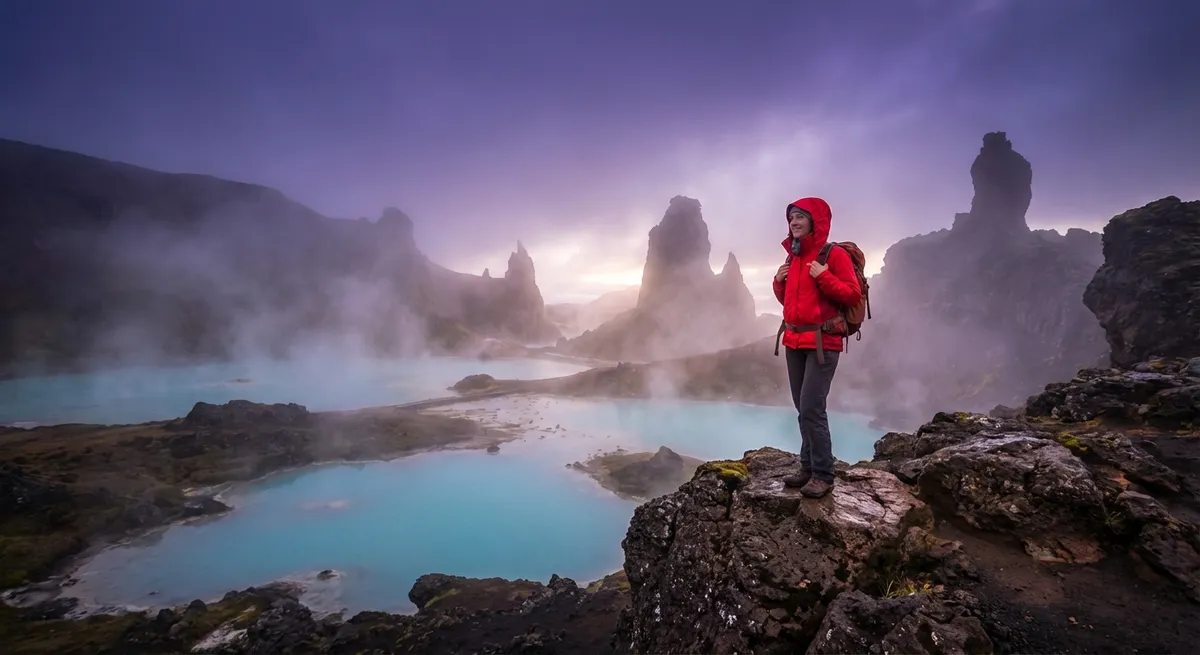
This isn’t about ticking off famous landmarks. It’s about chasing those rare corners of the world where the landscape rewires your imagination—and bringing back a braver version of yourself.
1. Volcanic Frontiers: Walking on Newborn Earth in the Azores, Iceland & Hawai‘i
Volcanic islands are Earth mid-sentence—still rewriting themselves as you walk across them. In Iceland, midnight sun ignites black sand, glaciers pour into volcanic plains, and steam vents whisper from the ground like the planet is breathing beneath your boots. The Azores rise out of the Atlantic like emeralds cast into deep blue, with crater lakes and hydrangea-lined roads that feel more like a dream than a destination. On Hawai‘i Island, you can watch molten rock harden into fresh land, then hike across lava fields that look like crumpled moonlight.
To really feel these places, get close to their edges. Hike between fumaroles in Iceland’s geothermal valleys, kayak the cobalt caldera lakes of São Miguel in the Azores, or take a guided trek across solidified lava near Hawai‘i Volcanoes National Park. Pack layers—the weather shifts fast around volcanic systems—and wear sturdy boots that handle uneven rock and sudden rain. These are living landscapes, so follow local guidance and park rules; eruptions and gas levels can change day by day. Volcanic destinations demand respect, but they offer something rare in return: the chance to watch a planet invent itself.
2. Desert Galaxies: Dunes, Stars, and Silence in Namibia & Jordan
Deserts are often called empty, but when you’re standing among towering dunes and the sky erupts with stars, “empty” is the last word that comes to mind. In Namibia’s Namib Desert, wind-sculpted dunes glow in shades of apricot, rust, and deep orange, and skeleton trees stand frozen in time against baked white clay pans. In Jordan’s Wadi Rum, red sandstone mountains rise from the sand like the ruins of an ancient, alien city, and sunset turns the entire valley into molten copper.
The magic of desert destinations sits in their extremes—light and dark, hot and cold, silence and sudden bursts of life. To experience them fully, aim for sunrise or sunset hikes when temperatures drop and shadows carve surreal patterns across the sand. Sleep in a desert camp and stay awake long enough to see a sky carved with constellations; with so little light pollution, it can feel like you’re drifting through space. Pack a scarf or buff to shield from sand and sun, and drink more water than feels necessary. Deserts teach a subtle kind of bravery: how to be still, how to listen, and how to find beauty where others only see “nothing.”
3. Ice Kingdoms: Blue Worlds and Quiet Awe in Antarctica & Patagonia
Frozen destinations have a way of stripping life down to its essentials. In Antarctica, icebergs the size of cathedrals drift through steel-blue water while penguins launch themselves like tiny torpedoes from the sea onto floes. In Patagonia’s southern reaches, glaciers calve thunderously into turquoise lakes, and serrated peaks tear at the sky. These are not passive landscapes; they crack, groan, roar, and remind you that wilderness is never ornamental.
Traveling into icy regions is more expedition than vacation, and that’s precisely the draw. Zodiacs cut through frigid water in Antarctica as you glide between ice formations that seem lit from within. In Patagonia, you can strap on crampons and crunch across glacier surfaces, dipping your bottle into meltwater that’s been frozen for centuries. Clothing here is your lifeline: think layers—base, mid, waterproof outer—plus gloves, hat, and sunglasses to protect against intense glare from snow and ice. Book with reputable operators who prioritize environmental protection; these ecosystems are fragile, and your choices directly affect them. Standing in that icy silence, you understand the real meaning of “remote”—and the privilege of reaching it.
4. Bioluminescent Nights: When the Water Starts to Glow
Few travel moments feel as otherworldly as watching the sea ignite with light under your fingertips. In places like Puerto Rico’s Mosquito Bay, Vieques, or the bioluminescent bays of Jamaica and parts of Southeast Asia, microscopic organisms called dinoflagellates turn agitation into a burst of electric blue. Every paddle stroke, every movement of a fish, and even your own hands trailing in the water leave luminous trails like liquid stars.
To catch this phenomenon at its best, time your visit around a new moon or the darkest possible night; bright moonlight can dim the effect. Choose operators who use kayaks or non-motorized boats to reduce disruption to the ecosystem and preserve the dinoflagellates. Wear quick-drying clothes and avoid sunscreen or lotions right before you head out—they can harm the delicate organisms. Bioluminescent bays are a reminder that the line between science and magic is thin; once you’ve watched water glow where your hand just was, the ordinary world feels upgraded.
5. Vertical Worlds: Hanging Villages and Cliffside Paths in Peru, Italy & Beyond
Some destinations stretch not outward, but upward. In Peru, the Sacred Valley and Machu Picchu cling to mountain ridges, terraced fields spilling down slopes like stairways for giants. In Italy’s Cinque Terre and Amalfi Coast, pastel villages cascade towards the sea, stitched to cliffs by staircases, footpaths, and impossibly narrow roads. In these vertical worlds, every step earns you a new angle on the landscape—and a fresh jolt of awe.
To fully step into these destinations, you have to accept the climb. Trade buses for footpaths when you can: hike into Machu Picchu via the Inca Trail or alternative routes, walk between Cinque Terre’s villages on coastal trails, or tackle stairways that local residents use daily. Travel light; every extra kilogram in your backpack will feel amplified on those steep ascents. Broken-in shoes, a refillable water bottle, and a respect for local pace and altitude will carry you farther than you think. The reward isn’t just the view from the top; it’s the way your body and mind recalibrate when effort and beauty are woven together step after step.
Conclusion
Destinations that feel like other planets don’t just change your photo gallery—they change your internal landscape. Volcanic coasts, desert skies, glacial kingdoms, glowing seas, and vertical villages all ask the same quiet question: “How willing are you to be astonished?”
You don’t have to visit them all at once. Start with one place that scares you a little and excites you a lot. Chase the terrain that doesn’t look like your daily life, and let it challenge the stories you tell yourself about who you are and what you can handle.
The map isn’t finished. It’s waiting for your footprints in the margins—where the familiar ends, and the adventure finally begins.
Sources
- Iceland Travel – Official Tourism Site – Overview of Iceland’s volcanic landscapes and safety considerations
- U.S. National Park Service – Hawai‘i Volcanoes National Park – Information on active volcano areas, hikes, and visitor regulations
- Namibia Tourism Board – Namib Desert & Sossusvlei – Details on dunes, climate, and travel tips for visiting the Namib Desert
- NASA – Bioluminescence and the “Living Light” of the Ocean – Scientific explanation of bioluminescent organisms and where they’re found
- UNESCO World Heritage Centre – Historic Sanctuary of Machu Picchu – Background on Machu Picchu’s location, cultural significance, and conservation status