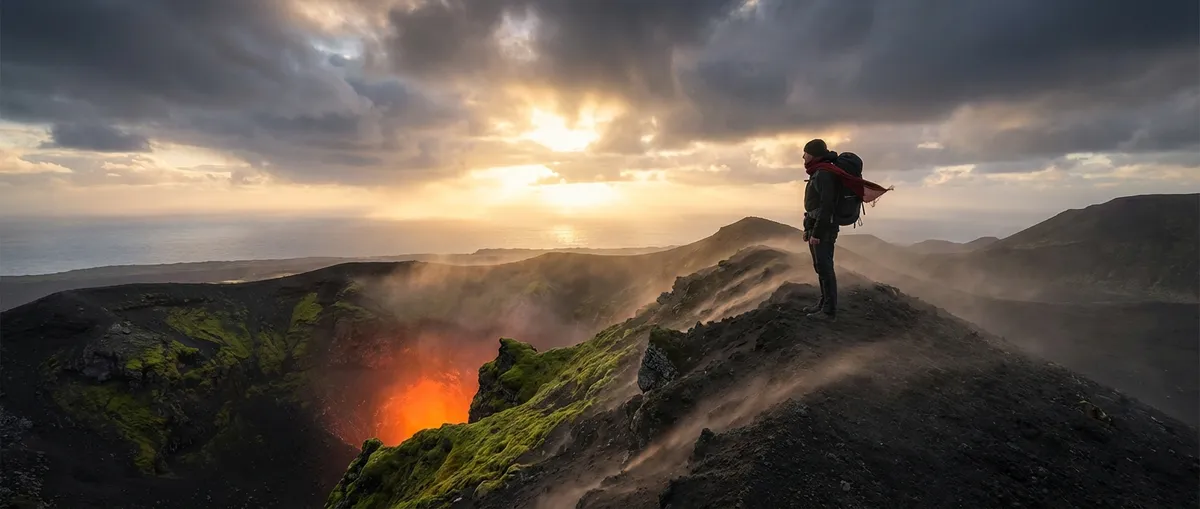
This is your invitation to chase those living landscapes—places where nature, culture, and your own curiosity collide. Below are five kinds of destinations that feel vividly, unapologetically alive, each with ideas on where to find them and how to tap into their full power.
1. Volcanic Worlds: Walking on a Restless Planet
Few experiences remind you that Earth is still forming under your feet like standing on a volcanic landscape. The ground feels young, the air sometimes smells faintly of sulfur and smoke, and every rock looks like it just cooled yesterday. In these places, the planet isn’t a backdrop—it’s an active character in your story.
Think of Hawaiʻi’s Big Island, where hardened lava fields roll toward the sea like black waves, or Iceland’s geothermal valleys, where steam vents hiss from the earth as if it’s quietly exhaling. In Sicily, Mount Etna looms over vineyards whose flavor is shaped by ancient eruptions. Even when volcanoes are dormant, the terrain they sculpted feels charged—lava tubes to crawl through, obsidian fields that glitter, craters that curve around you like amphitheaters built by time.
To travel these worlds well, pack sturdy shoes, layers for sudden weather shifts, and a deep respect for local safety rules. Always check official park or geological service sites before hiking near active areas; conditions change quickly, and lava, gas, and unstable ground can turn dangerous fast. Go with local guides when possible—they read the land like a language and can point out subtle details you’d otherwise miss, from tiny heat vents to fresh fractures in the rock. Volcanic destinations aren’t just about the thrill of fire; they’re about understanding that the ground you trust is anything but static—and that’s exactly what makes it feel so alive.
2. Tidal Edges: Where Land and Ocean Trade Places
On coasts shaped by powerful tides, the world seems to inhale and exhale twice a day. Beaches vanish and reappear, seaweed forests rise from the shallows, and boats that floated at sunrise might be resting in the mud by afternoon. To stand at the tidal edge is to watch time move in water.
At places like the Bay of Fundy in Canada—home to some of the highest tides on Earth—the difference between low and high tide can feel unbelievable. You can walk the ocean floor among sculpted rock pillars in the morning and kayak at their base when the water returns. In parts of Western Europe, intricate tidal flats stretch toward the horizon, dotted with winding channels and migratory birds. Asia’s broad estuaries and mangrove coasts play host to entire ecosystems that appear and disappear with the rhythm of the tide.
To truly experience a tidal destination, you can’t just show up—you have to sync your day to the moon. Study local tide charts, which are often available online from port authorities or meteorological services. Plan walks, boat trips, and photography sessions around tidal extremes, and always obey posted warnings about incoming water; fast tides can trap the unwary. Pack quick-dry gear, water shoes, and a sense of flexibility—plans here bend with the surf. When you match your tempo to the tide, you begin to feel every rise and fall not as a schedule risk, but as a wonder to chase.
3. Night Skies Sanctuaries: Destinations That Switch On After Dark
Some of the most unforgettable destinations don’t reveal their magic until the sun disappears. When you step into a true dark-sky region, you realize how much of the world you usually miss after sunset. The Milky Way spills across the sky like spilt light, meteor trails scratch brief silver scars overhead, and constellations you’ve only seen on apps suddenly feel close enough to touch.
From desert plateaus in the American Southwest to high-altitude valleys in the Andes, dark-sky parks and reserves protect the night from artificial light, unlocking a whole new frontier for exploration. In these places, astronomy and adventure blend: you might hike to a remote ridge for stargazing, soak in natural hot springs while watching the heavens turn, or camp in silence as nocturnal animals call from the shadows. In Arctic and sub-Arctic regions, the sky itself seems to dance as the aurora borealis ripples in green and violet arcs.
To get the most from these destinations, time your travels around moon phases (new moons give the darkest skies) and seasons with clear weather. Red-light headlamps protect your night vision, and a simple tripod turns your phone or camera into a gateway to astrophotography. Dress far warmer than you think you’ll need—standing still to stargaze gets cold, fast. By trading late-night bars for late-night constellations, you discover a quieter kind of nightlife, one that feels ancient, vast, and humbling in the best way.
4. Seasonal Shape‑Shifters: Destinations That Become New Worlds Each Month
Some destinations reinvent themselves so completely with the seasons that visiting once feels like only half the story. A valley that blazes with sunflowers in summer may freeze into a blue-ice canyon in winter. A city that feels slow and sun-washed in August might explode with lanterns, festivals, or snow markets in another season. These shape-shifting places invite you to return, to see who they’ve become—and who you are when you meet them again.
Consider alpine regions that swap wildflower meadows and hiking trails for powder-coated slopes and ice-climbed waterfalls. Think of Japan’s shifting calendar of cherry blossoms, fiery maples, snow festivals, and humid green summers. Even familiar cities like Paris or Seoul feel transformed between misty winter mornings and long, glowing evenings on café terraces. Rivers swell and shrink; animals migrate or hibernate; local foods rotate from fresh harvests to hearty, fire-warmed dishes.
When planning, look beyond the “best time to visit” clichés and instead ask: what version of this place do I want to meet? Research local festivals, migratory seasons, or natural phenomena like autumn foliage or spring bloom. Pack for changeable weather and build a bit of slack into your schedule; seasonal destinations are at their best when you give them room to surprise you. You may find yourself drawn back at a different time of year, chasing a second chapter in a story that never quite repeats itself.
5. Borderland Cities: Where Cultures Collide and Coexist
Not every living landscape is made of rock and water—some are built of language, food, and the hum of overlapping histories. Borderland cities and crossroad hubs feel as if they’re in motion even when you’re sitting still at a café table. Here, you can hear multiple languages on a single street, taste centuries of trade routes in one meal, and walk from one cultural rhythm into another just by crossing a river or tram line.
Think of cities perched on continental or cultural fault lines, where influences mingle in architecture, music, and markets. You might find Ottoman arches next to Art Nouveau facades, street food stalls sharing space with old-world bakeries, or a festival calendar packed with celebrations from multiple traditions. These places are portals: today’s cityscape often holds traces of borders that shifted, empires that rose and fell, and communities that stayed and wove something new.
To travel these cities deeply, let curiosity be your compass more than landmarks. Wander markets and transport hubs, where cultures naturally meet. Take local public transit across town and note how the neighborhoods change. Seek out small museums, community centers, and independently run walking tours that focus on history, migration, or food—these are often where the city explains itself best. Learn a few phrases in more than one local language; even a simple greeting can unlock stories. In borderland cities, you’re not just visiting a place—you’re stepping into an ongoing conversation.
Conclusion
Destinations that feel alive don’t wait politely for you to arrive with your checklist. They’re shifting under the tides, cooling from ancient eruptions, darkening into star-filled skies, transforming with the seasons, and buzzing in the spaces where cultures meet. When you choose these kinds of places, travel stops being a string of photo stops and becomes something more like a dialogue—with the planet, with other people, and with yourself.
Let your next journey follow motion instead of just maps. Ask where the world is changing fastest, where the elements are most expressive, where humanity has layered stories thickest—and go there ready to listen, watch, and move with it. The more alive your destinations feel, the more awake you’ll feel moving through them.
Sources
- US National Park Service – Volcanoes - Overview of volcanic landscapes, safety information, and notable parks with volcanic features
- U.S. Geological Survey – Volcano Hazards Program - Real-time monitoring, maps, and guidance for visiting volcanic regions safely
- Environment and Climate Change Canada – Tides in Canada - Explanation of tidal phenomena, including the Bay of Fundy and high-tide dynamics
- International Dark-Sky Association - Directory and details of certified dark-sky parks and reserves around the world
- Japan National Tourism Organization – Seasons & Festivals - Seasonal highlights and cultural events illustrating how destinations transform throughout the year