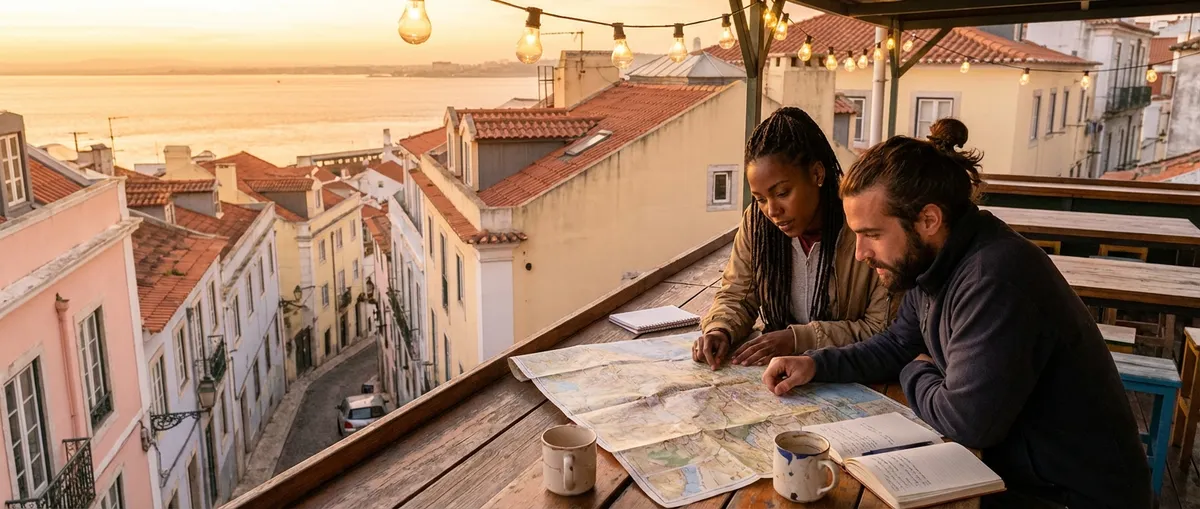
Below are five powerful, budget-friendly shifts that don’t just save money—they transform the way you move through the world.
1. Chase Sunrises Instead of Souvenirs
Souvenirs fade; dawn on a rooftop in a new city doesn’t.
When you’re traveling on a budget, the most unforgettable experiences are usually the ones that don’t cost anything at all. Set your alarm for an unreasonable hour and climb to any vantage point you can find: a hill above town, a quiet bridge across the river, a temple staircase, a public park viewpoint. Watching a new city slowly light up costs nothing, yet it gives you something money can’t fake—a sense that you’re seeing the place before the day’s performance begins.
Instead of wandering markets for trinkets, collect moments that anchor you to the place: the sound of fishermen shouting in the harbor at dawn, bakery ovens rolling out their first batch of bread, the way the sky over the old quarter turns from cobalt to gold. Take photos if you want, but also let yourself stand still, without your phone, and actually inhabit the moment.
In your budget, replace a line for souvenirs with a line for “scenic early starts”—maybe that’s a bus to a lookout point, a takeaway coffee for a chilly waterfront walk, or a local pastry to eat on some stone steps as the city wakes. You’re not cutting costs; you’re reallocating them to memories that live longer than fridge magnets.
2. Turn Transit Into Your Front-Row Seat to Local Life
The cheapest seat in town is often the most revealing.
Budget travelers know that public transportation is usually far less expensive than taxis or rideshares—but its real value goes beyond price. Buses, trams, metro lines, and shared minibuses are where the pulse of a place beats in real time. You’ll see school kids in uniforms, grandparents with market bags, workers in fluorescent vests, couples sharing headphones. This is where a city stops being a postcard and becomes a living organism.
Instead of treating transit as a nuisance, turn it into a part of your adventure. Study the map like it’s a treasure chart. Note the stops that end at rivers, hilltop parks, seaside promenades, or old neighborhoods with crumbly architecture. Use day passes or transit cards to hop on and off without worrying about each fare. Ask someone at the station booth or a fellow passenger, “If you had just one free afternoon, where would you get off this line?”
There’s a safety element, too: major transit systems often have well-documented routes, schedules, and rules. Before you arrive, check the official transportation website for maps, passes, and etiquette tips. When you align your budget with the way locals move, you’re not just saving money—you’re earning insight into how life actually flows there.
3. Eat Like a Local, Not Like a Visitor
Your budget doesn’t need white tablecloths to taste incredible.
Food is where many travelers bleed cash without realizing it—three restaurant meals a day add up fast. But some of the most memorable, affordable meals happen where menus don’t have tourist translations and tables are full of locals. Follow the smells, the lines, and the noise. A busy street stall or canteen with plastic chairs is usually a better bet than a half-empty restaurant with glossy menus in five languages.
The trick is to build simple, flexible “food rhythms” into your day. For example:
- A market breakfast: fresh fruit, local bread, coffee.
- A big local lunch at a place packed with residents on their break.
- A light, DIY dinner from a grocery store: cheese, bread, olives, seasonal produce.
Ask your hostel owner, guesthouse host, or barista where they eat when they don’t want to spend much. Learn a few key phrases like “What’s your most popular dish?” or “What do you recommend?” so you can order confidently even if there’s no English menu. And don’t underestimate bakeries and street stalls—these are often where the soul of a cuisine lives.
When you pivot from “Where do tourists eat?” to “Where does life happen around food?”, you’ll find meals that cost less, taste better, and plug you directly into the local rhythm.
4. Sleep in Places That Come With a Story, Not Just a Bed
Your accommodation is more than a place to drop your backpack.
On a tight budget, cheap doesn’t have to mean characterless. The world is full of stays that trade luxury finishes for personality and connection. Think family-run guesthouses, hostels in historic buildings, eco-lodges on the edge of small towns, or farm stays where your “room key” comes with fresh eggs in the morning.
Before you book, decide what you really want your accommodation to do for you. If you’re craving community, a good hostel with a shared kitchen and common area may be more valuable than a private hotel room you can barely afford. If you want quiet and nature, a simple cabin outside town might cost less than a central hotel yet give you sunsets, stargazing, and birdsong thrown in.
Look for accommodations that include extras that matter on a budget: free breakfast, kitchen access, bikes you can borrow, guided walks, or strong Wi-Fi if you’re working on the road. Read reviews with an eye not just for cleanliness, but for atmosphere: do people talk about warmth, kindness, and helpful staff? Those intangibles often matter more than thread count.
In the end, you’re not just reserving a bed—you’re choosing the backdrop for your stories. Let your budget steer you toward places with heart, not just polished lobbies.
5. Let Free Experiences Be the Backbone of Your Itinerary
The world’s best moments rarely come with a ticket price.
When you build your trips around free or low-cost experiences, your budget stretches like elastic—and your days fill with unexpected wonder. Museums with free-entry days, public beaches, city parks, temple grounds, walking tours, local festivals, and open-air concerts: these are the veins through which the life of a place flows, and many are open to anyone who shows up.
Before you go, search for:
- “Free things to do in [city]”
- “[city] official tourism site events calendar”
- “Museum free days [city]”
- “Community festivals [month] [region]”
Then, sketch your itinerary around these no-cost anchors. Maybe you plan your arrival for a night market, your Sunday around a free city walking tour, or your weekday afternoon around a museum’s discount hours. Build in flexible time for simply wandering: neighborhood streets, riverside paths, or outdoor art installations.
Use your budget for a few high-impact, paid experiences that truly light you up—like a cooking class, a hike with a guide, or a boat trip—and let the rest of your time be shaped by what doesn’t require your wallet. You’re not depriving yourself; you’re giving yourself room for serendipity to do its work.
Conclusion
Budget travel is not a consolation prize for people who can’t “afford” real adventures. Done with intention, it is the real adventure: sharper, closer to the ground, more plugged into the ordinary magic of daily life in other places. When you swap souvenirs for sunrises, taxis for tram rides, fancy restaurants for market stalls, and chain hotels for story-filled stays, you don’t just save money—you expand your capacity for wonder.
Your next trip doesn’t have to wait for a bigger paycheck. It’s built from choices you can start making now: what you value, where you’re willing to be uncomfortable, and how much you’re willing to trade certainty for discovery. Pack your curiosity, guard your budget like a compass, and step out the door. The world is still wide open to those who know how to travel on purpose.
Sources
- U.S. Department of State – Travel.State.Gov - Official travel advisories and safety information to consult before planning budget routes and destinations
- OECD Tourism Trends and Policies - Data on tourism patterns, including insights into how travelers are shifting toward more sustainable, experience-focused travel
- Lonely Planet – Budget Travel Tips - Practical budget strategies for transport, food, and accommodation from a major travel publisher
- Rick Steves Europe – Money-Saving Travel Tips - Detailed guidance on stretching your travel budget, particularly in Europe, while still having rich experiences
- National Park Service (NPS) - Information on U.S. national parks, many of which offer free or low-cost experiences ideal for budget-minded adventure travelers