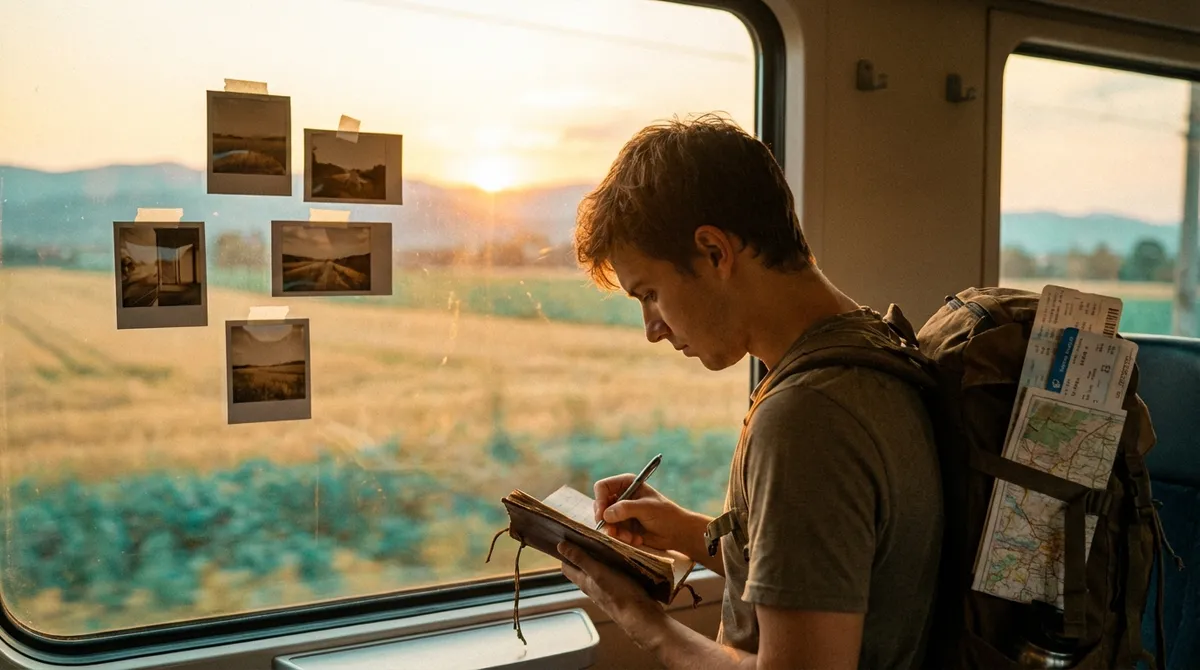
This isn’t about ticking landmarks off a list. It’s about learning to travel like a storyteller—chasing moments, details, and connections that make your adventure feel alive.
1. Design a “Theme” for Your Trip, Not a Checklist
Instead of building your travels around attractions, build them around a feeling or theme. That theme becomes your compass, guiding you toward richer, more personal experiences.
Maybe your theme is “rivers and rooftops,” so you seek out cities with river walks and high viewpoints: rooftop cafes in Lisbon, riverside night markets in Bangkok, bridges over the Danube in Budapest. Or maybe it’s “old trains and small stations,” so you choose scenic rail routes and linger in in-between places most travelers speed past.
Choosing a theme helps you say yes and no with intention. When you’re overwhelmed with options, you can ask: “Does this fit my story?” Suddenly, your plans feel less like logistics and more like chapters in a book. Themes can be moods (slow mornings, late nights, street music), elements (water, mountains, deserts), or experiences (local markets, historic cafés, hidden staircases).
A themed trip also makes your memories easier to recall and share later—your photos, journal entries, and videos all orbit around one bright idea. That cohesion can turn an ordinary itinerary into a personal legend.
2. Treat Dawn and Dusk as Secret Powers
There’s a different world hiding at the edges of the day. If you only explore between 10 a.m. and 6 p.m., you miss some of the most enchanting hours a place has to offer.
At dawn, cities and villages are stripped of their noise and armor. You might see bakers sliding bread into ovens, temple courtyards washed in soft light, fishermen gliding across still water, or streets being swept clean before anyone fills them. This is when you can reclaim famous sites—sunrise at Angkor Wat, a nearly empty Piazza San Marco, or quiet lanes in Kyoto—without the crush of crowds.
At dusk, the mood shifts again. Golden light melts into neon. Food stalls sizzle to life. Locals head out for evening walks, open-air cinemas, night markets, or beach sunsets. These are the hours for rooftop viewpoints, river cruises, twilight hikes, and slow wanders where you watch a place transform in real time.
Build your days around these edges: nap in the afternoon if you need to. Schedule flights and train rides to arrive before sunset when you can, so your first impression of a new city is bathed in color, not harsh midday glare or disorienting darkness. Let light, not just time, shape your journey.
3. Use One “Anchor Habit” to Connect With the Place
When you land somewhere new, you’re surrounded by strangeness—in the best possible way. But constant novelty can be exhausting. A simple daily ritual can ground you and help you plug into the life of the place instead of hovering on the surface.
Choose one anchor habit and repeat it every day in a different setting. It might be:
- A morning coffee or tea at a small café or street stall
- A 20-minute walk in the same neighborhood at the same time
- A short run by the water, through a park, or along side streets
- Sketching or journaling on a bench, in a square, or by a window
- Buying one small item from a local bakery, fruit market, or snack stand
This ritual becomes your lens. By returning to the same kind of moment daily, you start to notice patterns: who passes by, which shops open early or close late, how the light shifts, how greetings change from day to day.
That small consistency creates a sense of belonging. You’re not just “the traveler who rushed through”; for a brief window, you’re part of the rhythm. It also helps ease anxiety and decision fatigue—no matter how chaotic the day, you know you’ll have that one familiar island of time.
4. Chase Micro-Adventures Inside Your Main Journey
Not every adventure has to be a multi-day trek or cross-country odyssey. Some of the best travel stories fit inside a single afternoon—if you deliberately create space for them.
Think of “micro-adventures” as bold detours tucked into your main trip. They’re small in time and scale, but big in memory. For example:
- Taking a local bus or tram to the last stop and exploring from there
- Joining a short cooking class in someone’s home rather than a big studio
- Renting a bike for just two hours to follow the river or coastline
- Hopping off one metro stop early to wander back without maps
- Riding a funicular or cable car to a hilltop you’d normally skip
The key is to let go of guarantees. Micro-adventures are defined by curiosity, not certainty: you might get a little lost, stumble into a festival you didn’t know existed, or find a viewpoint that never appears on “top 10” lists.
Some days your micro-adventure might be as simple as sitting in a local laundromat, listening to conversations and watching daily life. Other days, it could be a last-minute kayak session, an impromptu language exchange meetup, or a small-town detour from your train route.
These side quests stitch surprise and serendipity into your itinerary, turning a straightforward journey into something far more layered.
5. Capture Your Trip in Three Dimensions: Senses, Stories, and Strangers
Photos and videos are powerful, but they often flatten travel into visual snapshots. To truly relive a journey—and to share it in a way that resonates with others—capture it in three dimensions: through your senses, your stories, and your encounters with strangers.
Senses:
Pause and notice what you smell, hear, and feel. The diesel-and-salt air of a harbor, the echo of church bells, the scratch of old tram tracks, the texture of cobblestones under worn shoes. Jot these details in your phone notes or a pocket notebook. These are the sparks that reignite your memories years later.
Stories:
Every day, write down one moment that felt like a scene from a movie—funny, awkward, beautiful, or tense. It could be a missed train that led to a chance conversation, a thunderstorm that trapped you under a café awning, or the first taste of a dish you couldn’t pronounce. Describe what happened, how you felt, and what surprised you.
Strangers:
Be intentional about one real interaction per day. Ask your server what they’d order if they were you. Compliment someone’s shop display. Learn how to say “thank you,” “this is delicious,” or “what do you recommend?” in the local language, and use it. Respect boundaries and cultural norms, but stay open to small exchanges.
When you share your trip—whether on social media, in a blog, or just around a dinner table—these three dimensions help your story land. Instead of “here’s a cathedral,” you have: the chill of stone under your fingertips, the story of the volunteer guide who told you how the stained glass was hidden during the war, the way the organ’s low notes vibrated in your chest.
That’s the difference between travel as a slideshow and travel as a living, breathing narrative.
Conclusion
Travel doesn’t have to be a race across maps or a parade of postcard views. It can be a carefully woven story, shaped by the themes you choose, the hours you keep, the habits you create, the detours you welcome, and the way you collect moments.
When you travel like a storyteller, every city becomes a chapter, every bus ride a beat, every conversation a line of dialogue. You’re not just passing through—you’re writing yourself into the scenery, one vivid scene at a time.
The next time you pack your bag, don’t just ask, “Where am I going?” Ask, “What kind of story do I want to live?” Then step out the door ready to chase it.
Sources
- U.S. Department of State – Travel Tips - Practical pre-trip guidance on documents, safety, and preparation
- Centers for Disease Control and Prevention – Traveler’s Health - Up-to-date health, vaccination, and destination-specific advice
- UNESCO World Heritage Centre - Authoritative information on culturally and historically significant sites around the world
- BBC Travel – Features and Inspiration - In-depth stories and examples of immersive, narrative-driven travel
- National Geographic Travel - Exploration-focused articles that highlight sensory details, local culture, and adventure-oriented travel experiences