Below are five powerful shifts that turn any journey—weekend escape or long-haul odyssey—into something unforgettable and share-worthy.
1. Travel on “Local Time,” Not Just the Clock
Most travelers move on tourist time: late breakfasts, midday sightseeing, early dinners. The real life of a place often starts well before and after that.
Wake before dawn and walk a city as the streets are being washed, stalls are being set up, and bakeries are breathing out their first warm loaves. Notice who’s out: runners, workers, street sweepers, elders chatting in doorways. You’re seeing the skeleton of the city before the crowd pulls on its mask.
At night, don’t just chase bars—find the small lights: the corner noodle joint still steaming at midnight, the family playing cards under a streetlamp, the musician rehearsing in a dim doorway. These are the unscripted moments that make you feel like you slipped backstage.
Practical tip: pick one morning and one night in every destination where you commit to going out with no fixed agenda—just a general direction and open eyes. You will remember those aimless hours more vividly than any museum queue.
2. Pack for Freedom, Not for “What If”
Every extra thing in your bag is a small chain on your spontaneity. Overpacking doesn’t just weigh down your body; it anchors your decisions. The lighter you go, the faster you can say “yes” to the unexpected: a last-minute train, a steep village stairway, a cramped tuk-tuk, or a back-of-the-bike ride to somewhere unmarked on your map.
Instead of packing for every possible scenario, pack for your real patterns. If you rarely dress up at home, you probably won’t suddenly become a gala person on the road. Build a simple, repeatable uniform that you can layer, wash in a sink, and wear in different combinations. Focus on breathable, quick-dry fabrics and one pair of comfortable, all-purpose shoes you can walk five miles in without thinking about your feet.
To feel lighter mentally too, put your essentials in a small “freedom kit”: passport, a physical copy of important documents, a backup card, emergency cash in a different currency, a pen, and a paper list of crucial contacts and addresses. Knowing you can move quickly—with everything that matters in one place—turns hesitation into movement.
3. Make One Bold Ask in Every New Place
Most travelers stay politely at the edges of local life, watching through the glass. To step through it, you don’t need perfect language skills; you need courage for one real ask.
In every city or village, challenge yourself to ask one person for something that feels slightly daring but respectful:
- “What’s a food from here that visitors almost never try?”
- “Is there a view nearby that locals love but tourists miss?”
- “Do you know any local celebration or event happening this week?”
- “Where do you go to feel calm when life gets stressful?”
These questions open doors that guidebooks can’t see. A vendor might redirect you to a backstreet eatery with no English menu. A barista might send you to a rooftop only locals climb at sunset. A taxi driver might tell you about a neighborhood festival that turns into the highlight of your trip.
Approach people with visible appreciation: learn how to say “hello,” “please,” and “thank you” in the local language, and use them generously. Your bold ask, wrapped in respect and curiosity, often becomes an invitation into the real heartbeat of a place.
4. Build a Ritual That Grounds Every Journey
Trips blur together when you consume them like content. They become unforgettable when you create a meaning-making ritual you repeat everywhere you go.
Choose a ritual that fits your style:
- The First-Cup Ritual: On your first morning, find a café or street vendor, sit facing the street, and spend 20 minutes just observing—no phone, no guidebook. Sketch the scene with words in a small notebook: smells, colors, overheard phrases.
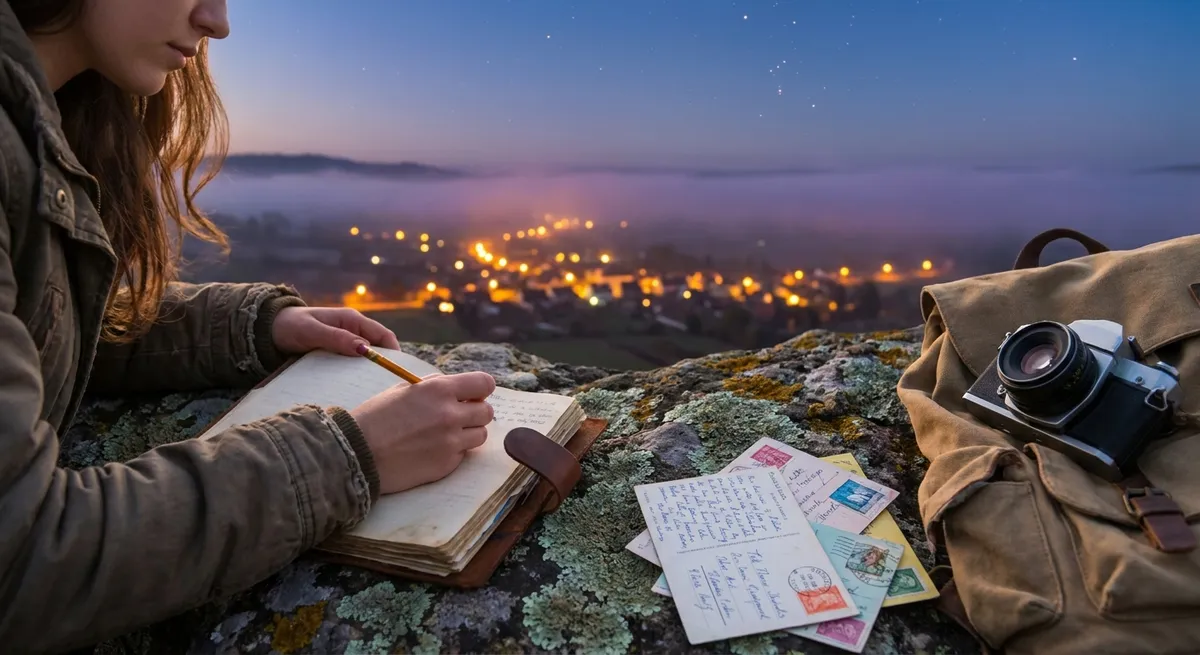
- The “Highest Point” Ritual: In every destination, climb to the highest easily accessible point—tower, hillside, rooftop bar, temple steps—and take a few minutes to look over the whole area in silence. Decide one intention for your time there and write it down.
- The “Last Hour Alone” Ritual: Before you leave a place, take 60 minutes to walk solo with no agenda except to say a quiet goodbye: to the corner you always passed, the bakery that remembered your order, the riverbank you sat beside.
Rituals turn movement into meaning. They give you a steady thread through wildly different places, and when you look back, those repeated moments of pause and reflection become anchor points in your travel story.
5. Turn Your Trip into a Living Story, Not a Highlight Reel
Social media loves the polished moment: the perfect beach, the picture-perfect meal, the cleanly edited sunset. But what makes a trip powerful isn’t perfection; it’s tension, surprise, and growth. Start documenting your travels like a story you’re living through, not a brochure you’re selling.
When you share online, don’t just post the best view. Share the missed train and what it forced you to discover. The restaurant that was closed, and the hole-in-the-wall that rescued your evening. The wrong bus that took you to the right village. The rainstorm that trapped you in conversation with a stranger under a shop awning.
Give your posts a narrative spine: “I thought X would happen, but then Y changed everything, and now I see Z differently.” People don’t just want to see where you’ve been—they want to feel what it did to you.
For yourself, keep a raw version of the story that never needs to be pretty: voice memos on late-night walks, notes typed half-asleep, quick sketches on train tickets. These unfiltered fragments become the treasure chest you open years later when the photos feel flat but the feelings still glow.
Conclusion
You don’t need a bigger budget, a longer vacation, or a stamp-filled passport to travel like your journey matters—you need intention, courage, and a willingness to be changed.
Move on local time. Pack light enough to follow your impulses. Ask brave questions that pierce the surface. Build rituals that turn each city into a chapter. Tell the whole story, not just the highlight.
The map doesn’t decide whether your trip is legendary. The way you move through it does. The next time you set out, don’t just go somewhere—step into the role of traveler as storyteller, and let the world write on you as much as you write about it.
Sources
- [U.S. Department of State – Travel Preparation Tips](https://travel.state.gov/content/travel/en/international-travel/before-you-go.html) - Official guidance on documents, safety, and practical preparation before traveling abroad
- [CDC – Travelers’ Health](https://wwwnc.cdc.gov/travel) - Up-to-date health advice, destination-specific notices, and vaccination recommendations for international trips
- [Lonely Planet – Responsible Travel Tips](https://www.lonelyplanet.com/articles/responsible-travel-tips) - Insightful guidance on engaging with local communities and cultures respectfully while on the road
- [National Geographic – How to Travel More Sustainably](https://www.nationalgeographic.com/travel/article/how-to-travel-more-sustainably) - Explores ways to travel lightly, reduce your footprint, and connect more authentically with destinations
- [Harvard Business Review – Why You Need a Travel Journal](https://hbr.org/2019/07/why-you-should-keep-a-travel-journal) - Discusses how documenting experiences enhances memory, reflection, and personal growth during travel