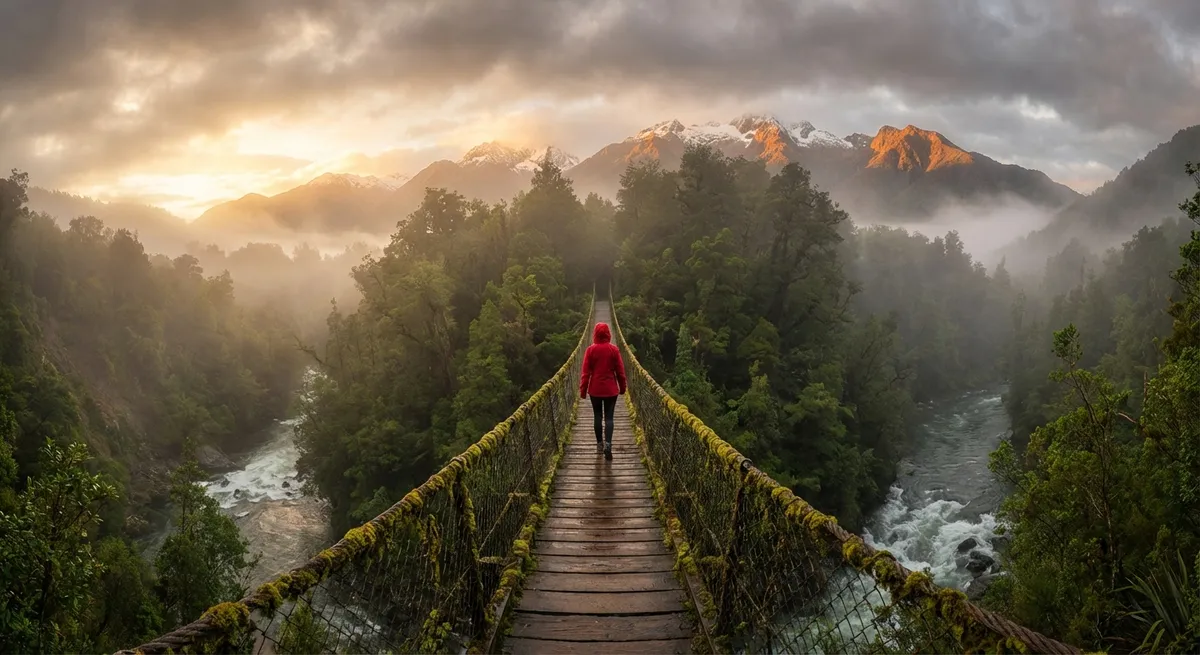
This isn’t about ticking countries off a list. It’s about choosing destinations where the journey itself is the main event—places that demand you move slower, pay attention, and let the route reshape you. From cliff-road buses to island-hopping ferries, these are the kinds of trips that turn travel days into the very reason you came.
1. The Train to the Clouds: Following the Spine of the Andes
Some destinations are best reached by surrendering to the rails. Riding a high-altitude train through the Andes turns what could be a simple transfer into a full-body immersion in altitude, culture, and endless horizon lines. As the train climbs, valleys slit open beneath you, snow-tipped peaks draw closer, and tiny villages flash by like living postcards.
The magic here isn’t speed; it’s the opposite. Long rail journeys teach you how to sit with the landscape instead of rushing past it. Pack a light layer for shifting temperatures, offline maps, and a small notebook—these routes are perfect for capturing impressions, sketches, or fragments of conversations with fellow travelers. Trains often have dining cars or snack vendors, but bringing local fruit and a reusable water bottle adds comfort without bulk.
Altitude can surprise even seasoned travelers, so acclimatize slowly: drink more water than you think you need, move gently when you disembark, and avoid heavy meals right before the highest stretches. When the tracks finally curve into your destination city, it won’t feel like you “arrived” in a single moment—you’ll feel as if you’ve grown your way there, mile by mile.
2. Desert by Starlight: Crossing Sands Where the Sky Takes Over
Most people see deserts at noon and decide they’ve understood them. But a desert crossing that stretches into twilight and night is a different universe entirely—one where the horizon dissolves and the sky claims full command. Whether it’s a camel trek, a 4x4 journey, or a guided hike, the destination isn’t just a dune camp or a remote oasis; it’s the moment you realize how small your usual world really is.
As the sun sinks, the sand cools and wind patterns trace new lines across the surface. Temperatures swing sharply, so layering is essential: a breathable base, a warm mid-layer, and a wind-breaking outer shell. A scarf or buff is invaluable—shade by day, warmth by night, and a barrier against blowing sand. Guided trips are worth the investment here; local guides read the desert like a library and know where safety, water, and shelter live.
When the stars break out, digital urgency falls away. With minimal light pollution, you’ll see constellations you’ve only known as dots on an app. If you can, download a stargazing app for offline use; try to identify at least one new constellation, and let that tiny act tether the memory to the sky forever. In the morning, watching the first sliver of sun light up dune ridges, you’ll realize the desert wasn’t just scenery—it rearranged your sense of scale.
3. Island-Hopping on Local Ferries: Stitching Together a Floating World
Some of the most alive destinations aren’t single islands, but entire archipelagos linked by ferries, fishing boats, and tide charts. Island-hopping on local boats turns a region into a living puzzle—each crossing a missing piece that slots the story together. Instead of flying over the water, you feel every mile: the salt on your skin, the hum of the engine, the shifting color of the sea.
Using public or local ferries instead of tourist-only boats plugs you straight into the daily rhythm of the place. You’ll share benches with commuters, families, and vendors hauling goods; the boat becomes an open-air classroom for understanding how people actually live with the sea. To keep it smooth, travel with a packable dry bag or waterproof pouch for electronics, and wear shoes or sandals that can handle wet landings and steep gangways.
Check timetables the old-school way—posted boards at docks or queries to dock workers—because schedules can change with weather and tides, even if online info says otherwise. Build buffer time into your itinerary; here, missing a boat can turn into an unexpected extra day in a fishing village that becomes your favorite memory. Each new island holds a different micro-world of dialects, dishes, and shorelines. By the time you’ve linked three or four together, the map in your head will feel more three-dimensional and alive than any guidebook could capture.
4. Forest Roads and Hidden Hamlets: Chasing Green Horizons
There’s a particular kind of destination that only reveals itself once you trade highways for single-lane roads and straight lines for hairpin turns. Driving, cycling, or even taking local minibuses through forested regions unlocks a quieter kind of adventure. The journey isn’t defined by one perfect viewpoint, but by a rolling sequence of river bends, misty valleys, roadside shrines, and tiny hamlets you’d never have found on an express route.
To make the most of this, think of your vehicle—bike, car, or bus seat—as a moving basecamp. Download offline maps and mark potential stopping points: viewpoints, trailheads, small towns with local markets. Have a loose plan, but give yourself permission to stop whenever the landscape tugs at you: a roadside stand selling wild berries, a trail disappearing into tall pines, a wooden bridge over a rushing stream. These pauses are where the forest starts talking to you.
If you’re driving yourself, learn basic road etiquette for the region—how to navigate single-track roads, when to yield, and where you’re allowed to pull off. If you’re taking buses, embrace uncertainty. Ask drivers and fellow passengers where they’d get off “if they had a day to wander,” and follow one of those suggestions. By the time you reach your final town or mountain lodge, you’ll carry not just photos of viewpoints, but an entire mosaic of quiet moments that add up to something far bigger.
5. Coastal Paths and Clifftop Towns: Walking the Edge of the Continent
Some destinations are best earned on foot, with the ocean beside you and the wind rewriting your plans every few minutes. Coastal walking routes that link small villages, lighthouses, and cliffside towns transform your trip into a moving story, one where the plot is the path itself. Instead of checking into a single resort, you step forward day after day, watching the coastline evolve in texture, color, and mood.
The beauty of coastal paths lies in their variety: you might be traversing grassy headlands, rocky coves, long sand beaches, and steep staircases carved into cliffs—all in a single day. Good footwear is non-negotiable: supportive, broken-in shoes with grip that can handle both wet stone and loose sand. A compact daypack with a light rain shell, plenty of water, and high-energy snacks keeps you agile enough to follow side-trails and linger on unexpected beaches.
Logistics can be surprisingly flexible. Some travelers carry everything and stay in different guesthouses each night; others base themselves in one town and use local buses, shuttles, or boats to reach different segments of the trail. Tides and weather become your co-guides—check tide tables and local forecasts religiously, and never underestimate the ocean’s ability to change conditions fast. The reward is a kind of slow-burn satisfaction: arriving in a cliff-top town by foot feels fundamentally different than rolling in by car. You didn’t just visit the coast—you traced it, step by step, and let it leave its lines on you in return.
Conclusion
Destinations that demand a journey—by rail, by sand, by sea, through forest, or along cliffside paths—ask more of you, but they give far more back. They slow you down, stretch your comfort zone, and turn “getting there” into the heartbeat of the entire experience.
When you choose places where the route matters as much as the arrival, you’re not just collecting stamps in a passport. You’re learning new ways to move through the world—ways that stick with you long after the trip ends and quietly reshape how you navigate your own life.
The next time you open a map, don’t just ask, “Where do I want to be?” Ask, “How do I want to get there—and what kind of traveler will I become along the way?”
Sources
- UNWTO Tourism Statistics - Global tourism data and insights on travel trends, including rail and sustainable journeys
- Eurail Official Site - Practical information on long-distance and scenic rail routes across Europe
- U.S. National Park Service – Hiking & Outdoor Safety - Guidance on preparing for hikes and multi-day walking routes, applicable to coastal and forest paths worldwide
- National Ocean Service (NOAA) – Tides and Water Levels - Educational overview on tides, essential for planning safe coastal journeys
- CDC Travelers’ Health - Health and safety recommendations for travelers, including considerations for high-altitude and remote-area trips