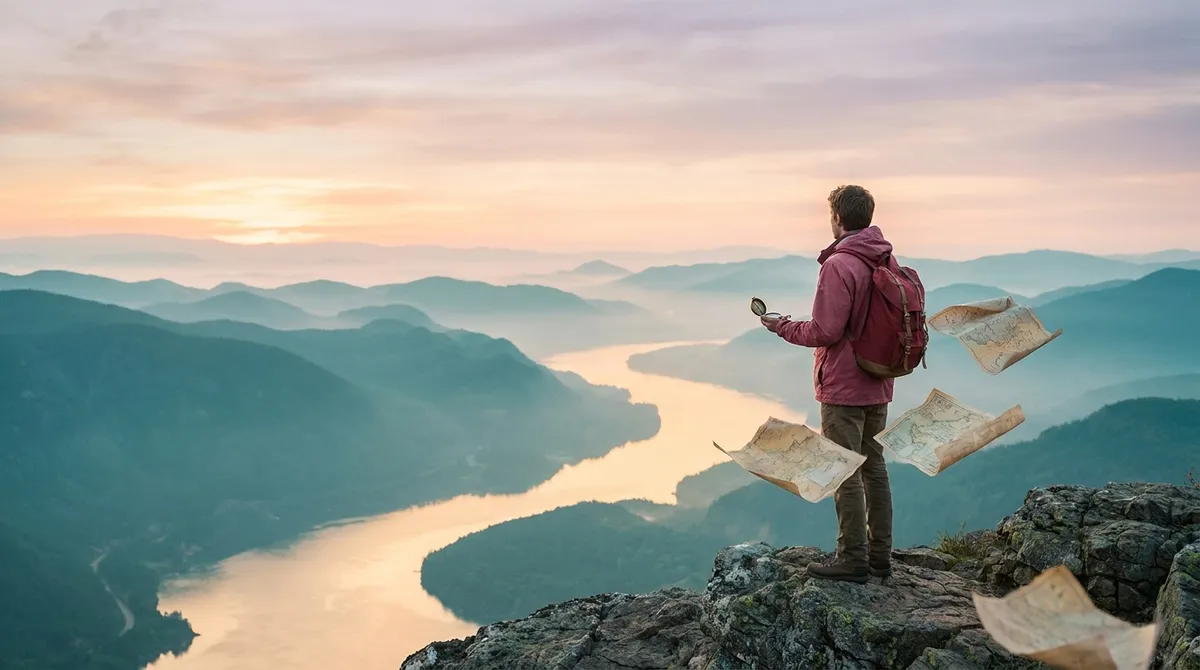
This guide is your nudge to step into the unfamiliar with intent, not just impulse. These five adventure ideas blend big-sky inspiration with practical details, so you’re not just dreaming—you're actually packing.
1. Follow the Water: From City Rivers to Remote Fjords
Water has a way of reshaping everything it touches—and that includes your sense of what’s possible. Whether you’re paddling a quiet urban canal at sunrise or gliding through a Norwegian fjord, water adventures pull you into slower, more attentive travel.
Start small by renting a kayak or stand-up paddleboard close to home. Look for guided tours if you’re a beginner; certified guides usually handle safety gear, local rules, and basic instruction, letting you focus on the view. Early mornings and golden-hour evenings bring calmer water, fewer crowds, and better light for photos.
If you’re leveling up, consider multi-day river trips where you camp along the banks. These journeys teach you to travel with only what fits in a dry bag, to read current and weather, and to find joy in the rhythm of paddle–rest–repeat. For colder or more remote waterways, research required permits, check water levels, and confirm you have the right clothing (layers, quick-dry fabrics, and a backup set in a dry bag are non-negotiable).
The payoff? A shift in perspective. Cities look different from the waterline; mountains feel bigger when you slide beneath them in silence. You stop racing to the next landmark and start traveling at the speed of the river.
2. Chase the Night Sky Instead of the Nightlife
The most unforgettable adventures often begin after dark—far from neon signs and crowded bars. Trading nightlife for night sky turns an ordinary trip into something quietly epic.
Seek out dark sky reserves, national parks, or remote countryside stays where light pollution is low. Use simple tools like light pollution maps to find promising spots, then time your trip around moon phases and seasonal constellations. New moon nights reveal the densest stars, while shoulder seasons bring crisp air and fewer crowds.
Pack for comfort and patience: a warm layer more than you think you need, a thermos, a blanket or compact camp chair, and a red-light headlamp (it preserves night vision). Even if you’re not chasing famous phenomena like the aurora borealis, you’ll see meteor streaks, the Milky Way, and constellations you never notice in the city.
Turn this into a ritual: stargazing after a long hike, counting shooting stars from a cabin porch, or taking a midnight walk along a quiet beach. These are the moments that shake you gently awake—the ones where you feel small in the best possible way.
3. Reboot Your Senses on a Slow Trail
Not every adventure is about adrenaline. Some of the deepest ones ask you to move slowly, notice everything, and let the map take a back seat. Trails—urban or wild—are perfect for this.
Choose a route that stretches you just enough: a multi-hour coastal walk, a day-long forest loop, or a city trail that strings together murals, markets, and hidden courtyards. Instead of sprinting from viewpoint to viewpoint, decide on a different kind of goal: collect sounds, colors, or small details. What does the air smell like after the rain? What’s growing in the cracks of the pavement? What does the local snack stand sell that you’ve never tried?
Practical prep matters. Good footwear and a small daypack with water, snacks, and a basic first-aid kit can turn a demanding day into a joyful one. Check trail difficulty and weather ahead of time, and download offline maps in case you lose signal.
The adventure here is internal as much as external: you relearn how to pay attention, you listen to your own pace, and you discover that a “slow” day can feel richer than cramming in a dozen attractions.
4. Say Yes to a Skill, Not Just a Place
A destination can be incredible; but pairing it with a skill you learn there turns the trip into a turning point. Instead of just going somewhere, ask: What could I come back knowing how to do?
This might mean taking a beginner climbing course in a mountain town, learning to surf on a mellow beach break, or signing up for a wilderness navigation or avalanche-awareness class in a snowy region. Even less extreme options—like multi-day photography, cooking, or wildlife-tracking workshops—change how you see and move through a place.
Look for programs run by certified instructors or reputable organizations; check reviews, safety standards, and the group size (smaller often means more hands-on help). Pack with your skill in mind: gloves for rope work, extra memory cards for photography, or a notebook for field notes and recipes.
The real treasure isn’t just the certificate or the photos; it’s the confidence that you can step into something new, be bad at it, learn, and improve. That mindset follows you home—and on every trip after.
5. Let One Train Ticket Rewrite Your Route
There’s a particular kind of magic in boarding a train without every hour of your journey planned. Rail travel slows the world down to a viewable speed: towns flicker past, mountains rise gradually, and you actually feel the distance you’re crossing.
Start with a route that gives you options—places where you can hop off for a night in a small town or shift to a regional line. Many countries offer flexible rail passes or regional tickets that reward wandering. Instead of anchoring your trip around one big city, treat the tracks as your spine and the stops as spontaneous detours.
Use luggage wisely: a backpack or compact rolling bag makes improvising easier than hauling oversized suitcases through stations. Save offline translations and maps, and learn a few key phrases for buying tickets, asking directions, or finding food.
This kind of adventure invites serendipity. You might discover a festival you didn’t know existed, a café that becomes “your spot” for two days, or a local recommending a lake, trail, or neighborhood that never appears on popular lists. You’re no longer just traveling to a place—you’re traveling through a story.
Conclusion
Adventure isn’t reserved for people with unlimited budgets or fearless hearts. It belongs to anyone willing to trade certainty for curiosity, routine for a little risk, and “maybe someday” for a concrete plan and a packed bag.
Follow water and let it reframe your sense of distance. Trade nightlife for galaxies. Walk slowly enough to finally notice where you are. Anchor your trips to skills that change you. And every so often, let tracks and timetables pull you off your usual path.
Your next move doesn’t have to be perfect; it just has to be honest. Pick one of these ideas, set a date, and let your comfort zone know it’s officially on notice. The map is waiting—what’s your next hop?
Sources
- [National Park Service – Trip Planning & Safety](https://www.nps.gov/subjects/travel/trip-planning.htm) - Guidance on preparing for outdoor adventures and staying safe in national parks
- [International Dark-Sky Association](https://www.darksky.org/our-work/conservation/idsp/places/) - Directory and information on certified dark sky places around the world
- [American Canoe Association](https://americancanoe.org/education/resource-library/) - Safety tips, skills resources, and best practices for paddling and water-based adventures
- [REI Co-op Expert Advice](https://www.rei.com/learn/expert-advice) - Practical gear guides and how-tos for hiking, camping, paddling, and climbing
- [Amtrak – Routes & Destinations](https://www.amtrak.com/routes) - Example of rail routes and flexible travel options for building train-based adventures