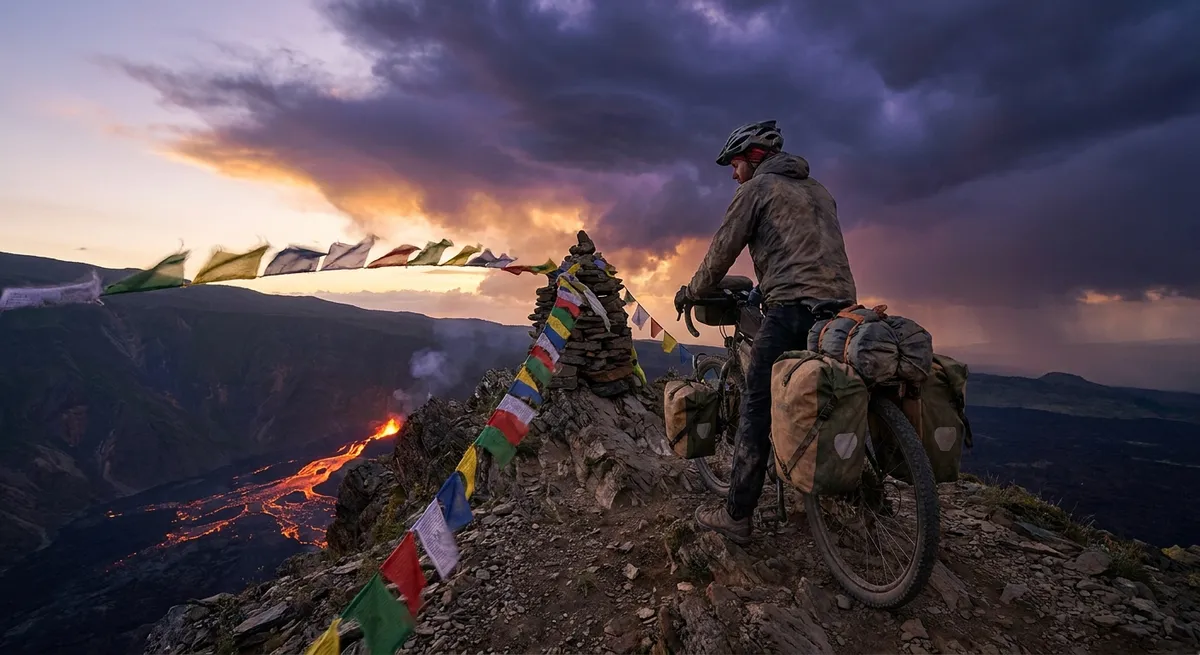
1. Mountain Ridges Where The Sky Feels Close
High-altitude destinations have a way of stripping life down to what matters. Think of the jagged silhouettes of the Dolomites in Italy, the sacred trails of Peru’s Andes, or the wild drama of Nepal’s Himalayan foothills. Up here, the air is thinner, the light is sharper, and the world below feels far away—like you’ve stepped onto the spine of the planet.
For adventurous travelers, these places deliver more than views. Sunrise hikes along knife-edge ridges, via ferrata routes clinging to cliffs, and multi-day treks that pass glacial lakes and tiny villages make every day feel earned. Start slow to adapt to elevation, hydrate more than you think you need, and plan buffer days in case weather rearranges your route. Pick one “big” objective—a summit, an alpine pass, or a mountain hut—and build easier explorations around it so your body (and confidence) can catch up. Up here, you don’t just look at the horizon; you walk along it.
2. Coastal Edges Where Land Simply Gives Up
There are shorelines that are pretty, and then there are coasts that feel like the earth is breaking open in front of you. Think Portugal’s wind-gnarled Algarve cliffs, the volcanic drama of Hawaii’s Big Island, or Iceland’s black sand beaches hammered by the North Atlantic. These are landscapes where the sea doesn’t just lap the shore—it attacks it.
Adventure grows naturally in places like this. Coastal trails run along the lip of cliffs, sea kayaks slip into sea caves glowing with refracted light, and surfers chase breaks that roll in from entire oceans away. To lean into the wild without losing your footing, check tide schedules, understand swell forecasts if you’re surfing, and book local guides for any sea cave or remote-coastline ventures. A light waterproof layer, dry bag, and reef-safe sunscreen go a long way. On these edges, the constant roar of the ocean becomes your travel soundtrack—and suddenly your everyday life feels very far inland.
3. Cities That Don’t Sleep (But Still Surprise You At Dawn)
Some destinations crackle with a current you can almost hear. Neon-lit Asian megacities, vibrant Latin American capitals, or European hubs where history and nightlife share the same corner can feel like they run on their own time zone. You wander laneways glowing with street food stalls, stumble on rooftop bars with citywide views, and realize that “late” and “early” are just opinions here.
The adventure in these cities isn’t only about staying out all night; it’s about letting the city set the rhythm for a while. Ride a rickety tram instead of a taxi. Follow your nose to a crowded food cart rather than a restaurant with a translated menu. Wake up in time for the first Metro or bus and watch the city yawn awake from a quiet viewpoint or riverside path. To keep it safe and bold, learn a few key phrases, drop pins in offline maps, and ask locals about neighborhoods to avoid late at night. These are destinations that change you not with adrenaline, but with constant, buzzing possibility.
4. Rivers That Pull You Through The Heart Of A Place
Follow a river long enough and you’ll see what a destination is really made of. From the lazy bends of the Mekong in Southeast Asia, to the canyon-carving Colorado in the U.S., to the story-rich Danube winding through Central Europe, rivers are the original highways of exploration. Drift, paddle, or raft a river and you don’t just move across a map—you cut through the landscapes and communities that actually define it.
Adventure here is a spectrum: multi-day whitewater expeditions that camp under a billion stars, easy kayak floats past vineyards and castles, or slow boat journeys that stop in villages you’d never find by road. Safety on the water starts with gear that fits: proper life jackets, helmets for whitewater, and dry bags for essentials. Respect water levels and seasons—some rivers are gentle in spring and dangerous in late melt, or the opposite. Let the river set your pace, and you’ll find yourself syncing with a slower, steadier heartbeat than your usual rush.
5. Wild Corners Where Dark Skies Still Win
There are destinations that impress you in daylight—and then there are places that wait until the sun drops to show you what they can really do. Dark-sky deserts, remote national parks, Arctic regions under the aurora, or high plateaus far from city glow all share the same magic: the night sky comes roaring back into focus. Suddenly, the Milky Way isn’t an idea; it’s a river of light overhead.
The adventure here is quieter but no less intense. Night hikes under full moons, campfires that glow under constellations you’ve never seen, or simply lying in a warm sleeping bag while meteor showers streak past: these are the kinds of nights that rearrange your sense of scale. Bring layers (temperatures plunge after dark), a red-light headlamp to preserve night vision, and if you’re chasing auroras or star photography, check space weather and cloud forecasts before committing. In these destinations, the most unforgettable moment of your trip might be the silence between stars.
Conclusion
The world will always have famous landmarks and checklist cities—but the trips you remember are the ones that ask something of you. A climb that leaves your legs shaking, a coastline that soaks you in salt and spray, a city that keeps you awake with possibility, a river that rewrites your route, a night sky that makes your worries feel small. Choose destinations that stir your nerve, not just your camera roll. The map is big, but your next bold step is small: pick one place that scares you a little in the best way—and hop next.
Sources
- [UN World Tourism Organization – Tourism Highlights](https://www.unwto.org/tourism-data/global-and-regional-tourism-performance) - Global and regional tourism data that helps understand travel trends and popular destination types
- [National Park Service (U.S.) – Night Skies](https://www.nps.gov/subjects/nightskies/index.htm) - Information on dark-sky parks, stargazing, and protecting natural night environments
- [International Dark-Sky Association](https://www.darksky.org/our-work/conservation/idsp/places/) - Directory of certified Dark Sky Places around the world, useful for planning stargazing-focused trips
- [Centers for Disease Control and Prevention – Travelers’ Health](https://wwwnc.cdc.gov/travel) - Health and safety advice for travelers to different world regions
- [American Whitewater – Safety Code](https://www.americanwhitewater.org/content/Wiki/safety:start) - Guidelines on river and whitewater safety for adventure travelers considering rafting or kayaking