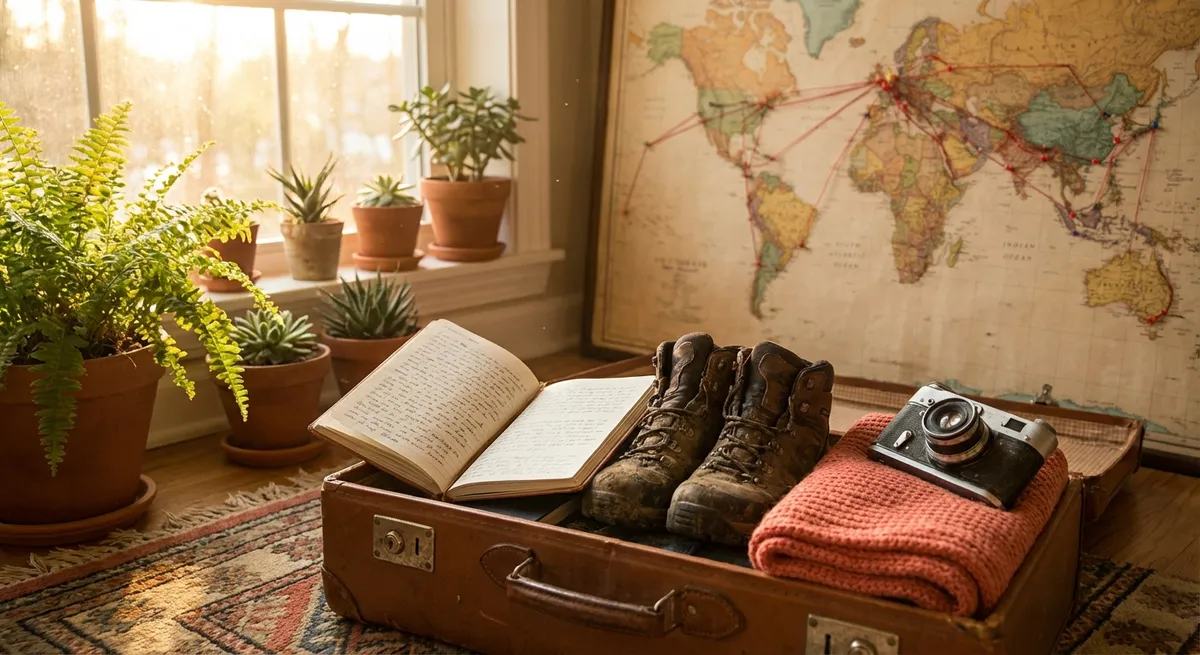
These five travel “rituals” aren’t just tips. They’re habits that turn any journey—budget or luxe, near or far—into something that feels big, meaningful, and wildly alive.
Turn Packing Into a Commitment, Not a Chore
Most people pack like they’re bracing for disaster. You’re going to pack like you’re declaring who you want to be on this trip.
Instead of asking, “What might I need?” ask, “Who am I on this journey?” Are you the sunrise-hiking, street-food-tasting, train-hopping version of yourself—or the poolside-novel, museum-lingering, slow-morning wanderer? Let that identity decide what makes it into your bag. Suddenly, your hiking shoes aren’t just shoes; they’re a promise that you’ll actually chase that summit. That swimsuit isn’t “just in case”; it’s a reminder to find the wildest waterfall or the calmest hotel rooftop pool.
Pack around experiences, not “what-ifs.” Build outfits that mix and match in layers: a breathable base layer, a warm mid-layer, and a weather-proof shell can carry you from mountaintop chill to humid night markets. Choose one color palette so everything works together, and anchor it with one pair of comfortable, all-day-walking shoes. Slip in one item that makes you feel invincible—a bold jacket, a favorite necklace, a hat that makes you walk a little taller. That’s not vanity; it’s fuel for confidence when you’re miles from familiar.
When you zip your bag, you’re not just closing a suitcase. You’re saying: this is the life I’m choosing for the next few days or weeks. Make sure what’s inside reflects that.
Land Softly: Design Your First 24 Hours With Intention
Your first day in a new place can decide the energy of your entire trip. Instead of stumbling off the plane into chaos, script your first 24 hours like a gentle takeoff into adventure.
Before you go, choose three things for your arrival day: one simple win (like finding a local bakery or café), one grounding ritual (a short walk, a stretch, or a shower the moment you check in), and one moment of awe (a viewpoint, a riverfront stroll, a neighborhood with serious character). Keep it light, flexible, and easy to achieve—even if your flight is delayed or you’re tired.
Hydration and sunlight are your secret weapons against jet lag and travel fatigue. Drink water regularly during transit, and when you arrive, get outside for at least 15–30 minutes in natural light. Walk the nearest block or two—not to “see the sights,” but to tell your body, “We live here now. This is home base for a bit.” Notice the smells, the sounds, the pace of the street. Let your senses arrive before your to-do list does.
Skip the urge to cram in major attractions on day one. Instead, locate your essentials: the nearest grocery shop or market, a place where locals grab coffee or tea, and how to reach your accommodation from a major landmark or transit station. Once you understand these anchors, the destination shrinks from intimidating sprawl to a navigable, living map.
Start soft, and the rest of your trip can go hard.
Chase Moments, Not Checklists
You’ll forget half the museum plaques you ever read. But you won’t forget the old man who taught you how to say “thank you” in his language, or the stranger who insisted you try a dish you’ve never heard of at a food stall at midnight.
Instead of building a rigid list of “must-sees,” choose a few “must-feel” experiences. Do you want to feel small next to something ancient? Energized by live music? Connected by a shared meal? Curious in a strange alley where you can’t read a single sign? Once you know the feeling you’re chasing, you can bend your plans to meet it.
Leave open blocks of time in your day labeled simply “Wander.” Follow the sound of music, the smell of bread, or the street that looks a little too interesting to ignore. Duck into courtyards, local parks, and side streets. Let your curiosity pick your direction. You can still visit the big icons—but let them be the skeleton of your trip, not the whole body.
Say “yes” a little more often, with smart limits. A spontaneous invite to a community event or local festival? If it feels safe, lean in. A hidden rooftop bar you spot while walking? Go up for one drink and a view. These micro-yeses are where trips shift from predictable to unforgettable.
You’re not a collector of locations; you’re a collector of moments. Build your days around the ones worth replaying.
Learn the Local Rhythm and Move With It
Every destination has a pulse—and if you move with it instead of against it, you stop feeling like a spectator and start feeling like a temporary local.
Start by noticing when places fill and empty. When do cafés buzz? When do families crowd the parks? When do streets quiet down? Use those patterns to plan. Visit popular sites early, when only photographers, runners, and early birds are out. Eat where the language on the menu matches what you hear at the tables around you. If a restaurant is packed with locals at odd hours, it’s worth your time.
Learn three things in the local language: a greeting, “thank you,” and “excuse me” or “please.” Use them constantly and sincerely. You’ll be surprised how quickly faces soften and how many doors open—literal and metaphorical. Respecting local customs, dress norms at religious sites, and basic etiquette isn’t boring; it’s how you earn the right to see a place as it truly is, not just how it performs for tourists.
Use public transport at least once. Buses, trains, trams, and shared vans show you the unscripted side of daily life—school uniforms, work bags, grocery runs, and sleepy commuters. They’re also often cheaper, more sustainable, and more efficient than taxis in crowded cities. Just keep an eye on your belongings and learn the route before you go.
Move with the rhythm, and suddenly you’re not just in a place—you’re part of its story for a brief, electric moment.
Capture Stories, Not Just Photos
Your camera can either flatten your trip into a highlight reel—or expand it into a living journal you can step back into years from now.
When you take photos, think in layers: wide shots to capture the scale of a place, medium shots for context (street corners, market stalls, train platforms), and close-ups of textures and details (hands making bread, cracked paint on a door, ticket stubs, street art). This way, you don’t just remember what you saw—you remember how it felt to stand there.
Balance documenting with being present. Try this rhythm: one photo burst, then phone away for at least ten full minutes of pure experience. Let the wind, the noise, the smells soak in without a screen between you and the moment. Later, you can jot a quick note in your phone or a pocket notebook: what the air felt like, something funny you overheard, what surprised you. These tiny descriptions become the glue between your memories and your photos.
Collect small story triggers instead of bulky souvenirs. A metro card, a stamped ticket, a handwritten receipt, a pressed flower from a park—all of these can anchor entire memories in an instant. When you’re back home, you can turn them into a scrapbook, a digital album with captions, or a single “trip box” you open whenever life feels too small.
Most importantly, remember you’re not just documenting places; you’re documenting your own evolution. The person who returns won’t be exactly the one who left—and that’s the real treasure you’re bringing home.
Conclusion
Every trip is a chance to reinvent not just where you are, but who you are.
When you pack like you mean it, script your first day, chase moments over checklists, slip into the local rhythm, and capture stories instead of trophies, your journey stops being a break from real life and becomes a rehearsal for a bigger, braver way of living.
You don’t have to go far or spend huge to feel it. You only have to decide: the next time you step out your door with a bag on your back, you’re not just going somewhere—you’re becoming someone.
Sources
- U.S. Department of State – Traveler’s Checklist – Official guidance on documents, safety, and preparation before international travel
- Centers for Disease Control and Prevention – Travel Health – Evidence-based advice on staying healthy abroad, including jet lag, hydration, and vaccinations
- BBC Travel – Why wandering is good for you – Explores the psychological and creative benefits of unstructured exploration while traveling
- National Geographic – How to travel like a local – Practical insights on connecting with local culture and customs respectfully
- Harvard Business Review – How to make your vacation more restful – Research-backed tips on planning trips that truly recharge you and avoid burnout