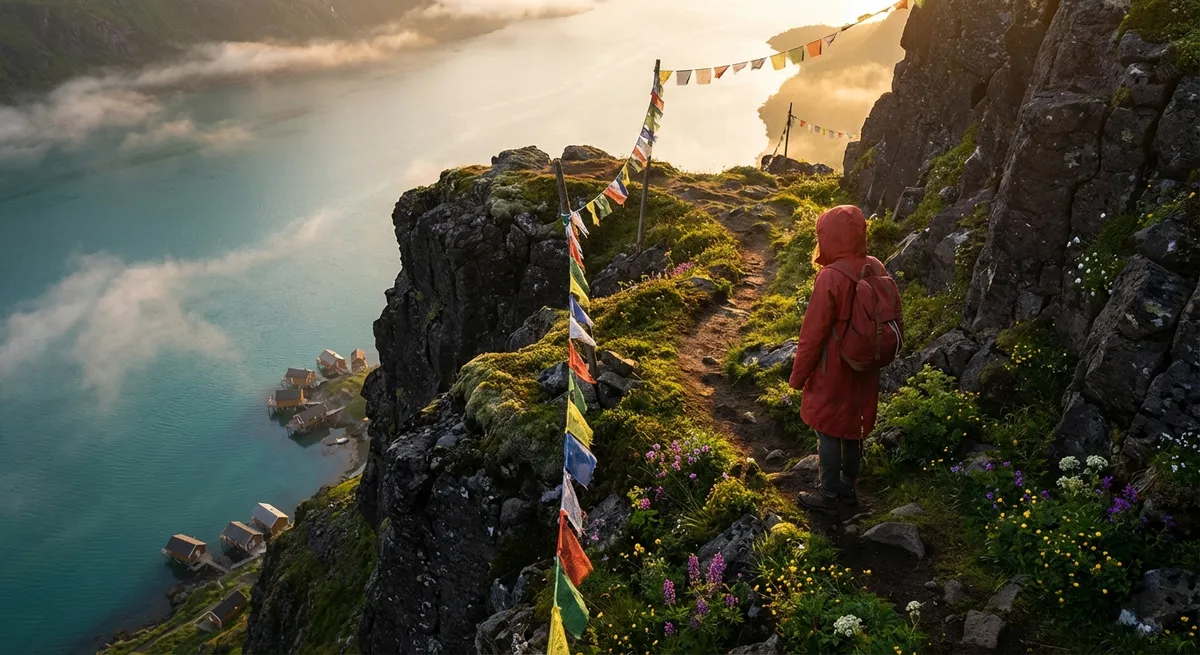
This is your guide to five kinds of places that feel like discoveries, not checkmarks. Use them as inspiration, swap in your own dream spots, and let them nudge you toward your next leap into the unfamiliar.
1. High-Altitude Towns Where the Sky Feels Closer
There’s a particular kind of quiet that only exists above the clouds. In high-altitude towns—think Andean villages, Himalayan hamlets, or alpine hideaways—the horizon pulls back and suddenly your everyday worries feel very small.
Mornings often begin with air so crisp it almost startles you awake. Light hits the mountains differently at altitude; shadows stretch long and dramatic, and colors snap into focus—bright prayer flags against grey rock, white snow slicing into electric blue sky. Street life moves at a different pace here. Locals carry decades of weather in the lines on their faces and walk paths your feet are just learning to trust.
Practical move: Start slow. Your body needs time to adjust to thin air, so plan gentler walks on your first couple of days and drink more water than you think you need. Book a guesthouse with a balcony or rooftop; simply sitting and watching the sun slide across the peaks can be as transformative as any trek. Learn a few words of the local language—gratitude, hello, goodbye—because up here, small acts of respect echo loudly.
2. Island Roads Where the Journey Is the Destination
Some islands are built for wandering. Not the resort kind, but the ones you circle by scooter, bike, or a beat-up bus, where every turn could be a cove, a cliff, or a tiny café that changes your whole day.
You feel it when the road pulls you along the edge of the sea, waves throwing white spray into the air, the scent of salt and exhaust mixing into something unforgettable. Sometimes the pavement breaks into potholes and dust, and that’s usually where the magic hides—a beach with only three people on it, a food stand serving whatever was just pulled from the water, a hilltop church or temple with views that silence every voice in your head.
Practical move: Travel with flexibility. Instead of locking in every hour, choose a simple base and give yourself “open road days” with only one rule: follow what looks interesting. Download offline maps, carry a physical map as backup, and always pack a sarong or light cloth—it can become a towel, sun shield, beach mat, or makeshift temple cover-up. Ask locals about their favorite viewpoints at sunset; rarely are they the same ones pinned on social media.
3. Night-Sky Destinations That Rewrite Your Sense of Scale
There’s a moment in truly dark places—far from city lights—when you look up and realize you’ve been under a dimmer switch your whole life. Desert plateaus, remote national parks, quiet rural valleys: under the right conditions, they all become observatories with no roof.
The Milky Way appears not as a smudge, but as a river of light. You start to notice the silence between sounds: the soft crunch of your shoes on dry ground, the rushing hush of distant wind, maybe the faint call of an animal you can’t see. Some destinations design experiences around this—guided stargazing, night hikes, or hot springs under the stars—but even standing alone in that darkness can be a kind of reset button. The universe feels bigger, but strangely, so do you.
Practical move: Time your trip with lunar phases and weather. New moons mean darker skies and brighter stars. Choose certified Dark Sky Parks or reserves when possible, and pack warm layers even in “hot” destinations—night temperatures can plummet. A simple star app on your phone (used sparingly to preserve your night vision) can turn stargazing into a quiet game of discovery. Respect local rules on light pollution: use red lights, keep beams low, and let the darkness stay wild.
4. Markets Where the World Meets in a Single Street
Some cities reveal themselves first through their markets. Morning or night, chaotic or calm, these are the places where life refuses to be curated: sizzling grills next to baskets of herbs you can’t yet name, shouts over the price of produce, children weaving through the crowd with the ease of locals who know every stall by heart.
Here, culture isn’t something on display—it’s something happening. You taste it in a bowl of soup served from a cart with three plastic stools, in bread still warm from a wood-fired oven, in fruit you’ve never seen before that drips down your wrist when you bite into it. Markets are where you learn how people actually live: what they cook, what they celebrate, what they consider worth waking up early for.
Practical move: Go twice—once in “watch and learn” mode, and once to participate. On your first visit, walk slowly, observe, and take mental notes. Buy something small: a snack, a spice, a single piece of fruit. On your second, try a full meal, attempt tiny conversations, and ask vendors (when they’re not busy) how to eat or cook what you’re buying. Carry small local currency, a reusable bag, and a dose of curiosity. Above all, be respectful of when and where it’s appropriate to take photos—people first, pictures second.
5. Borderlands Where Cultures Overlap and Blend
Some destinations don’t fit neatly inside one story because they sit between worlds—border cities, crossroads regions, places where caravans once stopped and armies once crossed. These are the spots where cuisines fuse, languages merge, and architecture tells you that history here has never been simple.
In these in-between spaces, you might find a single street where a mosque, church, and temple all share the same skyline. Menus blend spices and traditions across invisible lines; you order a dish with one name and taste three culinary histories in a single bite. Street art may speak multiple languages at once. The air carries layers of music, accents, and stories that don’t care about who drew which line on which map.
Practical move: Travel with curiosity instead of conclusions. Visit local museums and small cultural centers—they often explain the tangled history better than any quick online search. Take walking tours led by locals from different communities if possible; hearing more than one perspective turns a place from “interesting” into “essential.” Listen more than you speak, and ask open questions about identity, tradition, and change. These are not just pretty destinations; they’re living conversations.
Conclusion
Every truly unforgettable destination has one thing in common: it asks something of you. To slow down at altitude. To follow the road without a script. To look up longer than you look down at your phone. To listen carefully in crowded markets and overlapping cultures.
You don’t have to travel far or spend big to find places that feel like discoveries. Start looking for high places, dark skies, live-wire markets, tangled borderlands, and island roads wherever you are willing to go next. The map is only the beginning—the real destination is who you become when you step into the unknown and let it change you.
Sources
- International Dark-Sky Association – Find a Dark Sky Place - Directory of certified dark sky parks and communities worldwide, useful for planning stargazing-focused trips
- UNESCO World Heritage Centre – World Heritage List - Authoritative information on culturally and naturally significant sites, including historic towns, border regions, and mixed cultural landscapes
- World Bank – Life in the City: World Urbanization Prospects - Background on urbanization and the role of markets and public spaces in city life
- Centers for Disease Control and Prevention – Travel Health - Practical, up-to-date health and safety guidance for travelers, including considerations for high-altitude destinations
- UNWTO (World Tourism Organization) – Tourism Highlights - Global tourism data and trends that help contextualize popular and emerging types of destinations