This is your invitation to step off the safe path and into the kind of adventures that crack you wide open—in the best possible way. Not reckless, not careless, but alive, awake, and ready to meet the world as it really is.
Below are five types of “unscripted moments” that can turn an ordinary trip into a defining chapter of your life—plus how to navigate them with courage, curiosity, and just enough preparation to keep you safe.
When the Path Vanishes: Embracing the Unknown Turn
Sometimes the adventure starts with a wrong bus, a missed stop, or a fork in the trail that isn’t on your map. Your instinct might scream to backtrack. But what if, just this once, you lean in?
Picture this: you’re following a marked coastal trail, cliffs on one side, open sea on the other. A hand-painted sign points away from the main route, toward a small cove you’ve never heard of. No reviews. No guarantees. Just a possibility.
Choosing that unplanned turn—responsibly—is how you trade predictability for presence.
Here’s how to make these “vanished path” moments unforgettable instead of stressful:
- Set a safe boundary first. Decide your “turn-back” time before you leave the main route. That way, curiosity doesn’t bulldoze common sense.
- Carry basic non-negotiables. Offline maps, water, a charged phone, a small first-aid kit, and a light jacket can turn a misstep into an adventure instead of an emergency.
- Stay oriented to anchor points. Notice landmarks: a mountain ridge, a tower, a river bend. These visual anchors keep you confident if your app loses signal.
- Welcome the micro-discoveries. A beach with no footprints, a fruit stall with one elderly vendor, kids inventing games with bottle caps—these are the small, irreplaceable wins of wandering off-script.
The secret isn’t to get lost on purpose. It’s to allow small, calculated detours to remind you that the world is still bigger than any itinerary.
When the Weather Rebels: Turning Storms into Stories
Every traveler eventually curses a forecast. The monsoon arrives a week early. The aurora hides behind clouds. The desert night drops below freezing just as you unzip your “lightweight” sleeping bag.
Yet some of the most powerful memories are forged when the sky refuses to cooperate.
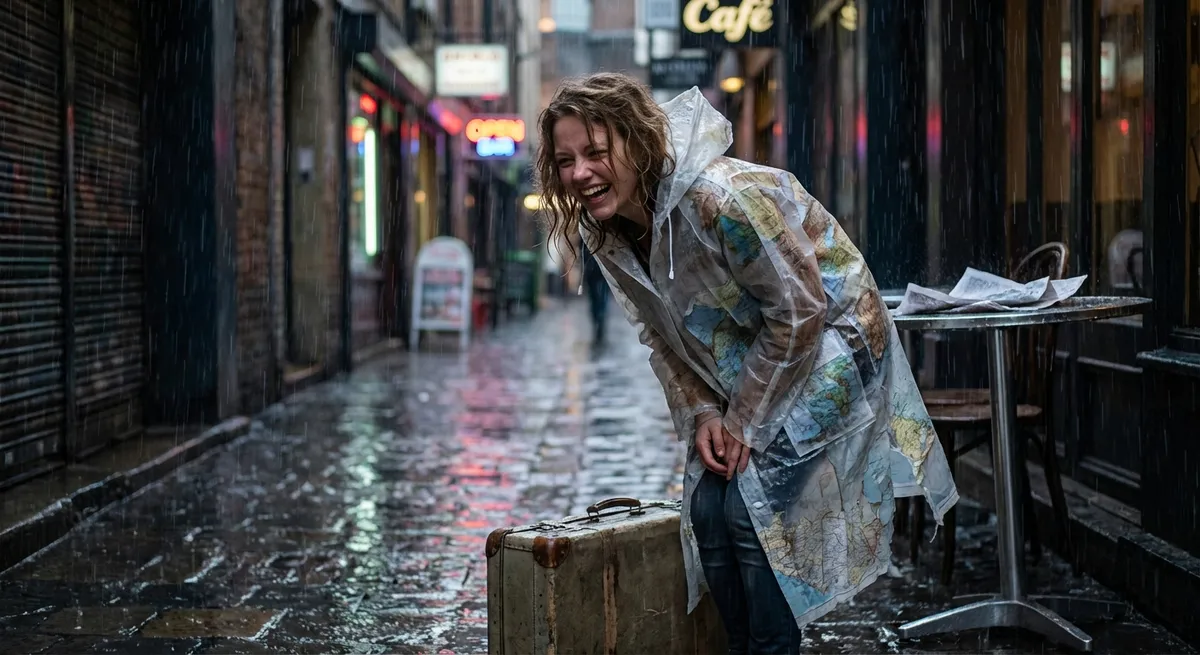
Think of rain that sends you running into a tiny café where nobody speaks your language—but everyone understands a shared pot of tea. Or a sudden snowstorm that cancels your road trip, keeping you in a mountain village long enough to witness a local festival you would have otherwise missed.
To turn “ruined plans” into rare experiences:
- Adopt a “Plan B, not Plan Broken” mindset. Before you arrive, list indoor or weather-neutral experiences you’d also love: local markets, hammams, neon-lit night walks, cooking classes, bathhouses, bookshops, or live music.
- Pack for surprise, not perfection. A compact rain jacket, quick-dry layers, and warm socks weigh little but buy you a world of freedom.
- Learn the weather’s rhythm. In many regions, storms follow daily patterns. Talk with locals: “When does the rain usually hit?” Planning for early mornings or late afternoons can carve out weather windows.
- Lean into the mood. Fog on a mountain lake, rain on cobblestones, wind along a cliff path—these conditions don’t just limit your trip; they change its texture. Slow your pace. Pay attention to sound, smell, temperature. Let the elements write the soundtrack.
You don’t travel for what is guaranteed. You travel for what is alive. Weather is the world’s reminder that you’re not the one directing this show—and that’s exactly what makes it feel real.
When Language Fails: Making Connection Without Words
There will be a day when your phrasebook betrays you, your translation app glitches, and you realize you have absolutely no idea what the person in front of you is saying.
This is not the end of communication. It’s the beginning of a different kind.
Imagine trying to buy vegetables in a small-town market where nobody shares your language. You mime chopping, pretend to stir a pot, point at your stomach and grin. People laugh, gesture back, throw in an extra tomato, and suddenly you are not a tourist shopping—you are a human being in a shared, ridiculous, joyful situation.
To turn language gaps into bridges:
- Master 10 anchor phrases. “Please,” “thank you,” “sorry,” “hello,” “goodbye,” “how much,” “yes,” “no,” “delicious,” and “bathroom” in the local language can soften almost any encounter. Pronunciation doesn’t have to be perfect; effort earns respect.
- Treat your hands as a second language. Pointing at menus, using fingers to show numbers, miming actions, and drawing simple sketches can get you closer than perfect grammar ever will.
- Let your phone be a sidekick, not a crutch. Download offline language packs and key phrases, but don’t hide behind the screen. Try first. Laugh at mistakes. Then use technology to clarify.
- Lead with humility, not entitlement. Approaching with a smile and an attitude of “I’m a guest here” turns miscommunication into collaboration instead of conflict.
When you drop the fear of “sounding stupid,” you gain something bigger: proof that human connection doesn’t need flawless words—only honest intent.
When Plans Collapse: Rebuilding Your Day from the Ruins
There’s a particular kind of silence when your long-awaited plan falls apart. The boat is overbooked. The hike is closed due to fire risk. The border crossing shuts down. The train workers go on strike two hours before departure.
In that blank space between disappointment and decision, you have a rare choice: cling to what should have been, or open your hands to what could still be.
Transforming a collapsed plan into a powerful pivot starts with how you respond in the first 10 minutes:
- Allow a short, honest meltdown. Sit down. Drink water. Swear into your journal if you need to. Let the frustration wash through instead of pretending you’re “totally fine.”
- Rename the day. Literally. Tell yourself, “Okay, this isn’t the ‘boat day’ anymore. This is the ‘explore-without-a-map day’ or the ‘locals-lead-the-way day.’” Sounds small, but this mental reframing gives your brain a new story to follow.
- Ask a real person, not just an algorithm. Hotel staff, café owners, bus drivers, park rangers—they know what’s possible today: side trails that are open, towns with festivals happening, lesser-known lookout points, or alternative routes.
- Chase the “second-choice” gems. Museums you hadn’t considered, neighborhoods that seemed too “ordinary,” small-town lakes, community sports events, sunset from a random hill instead of the famous viewpoint. Often, these backup choices turn into the very heart of your trip.
One day you may realize the highlight of your journey wasn’t the thing you flew across the world to do—but what you discovered after it fell through.
When Fear Shows Up: Using It as Your Compass, Not Your Cage
There’s a thin line between fear that protects you and fear that shrinks you. On the road, both will keep you company.
You’ll feel it standing at the edge of a cliffside trail. Before your first solo bike ride across a new city. When the boat looks smaller than the waves. When night feels a little too dark and unfamiliar.
The goal isn’t to eliminate fear. It’s to listen to it with discernment.
Use it as a compass like this:
- Ask, “Is this fear about safety or comfort?” Safety-fear says, “This road is icy and you’re not equipped.” Comfort-fear says, “You’ve never tried this before.” Honor the first without question. Challenge the second with curiosity.
- Take “micro-brave” steps. Instead of signing up for a week-long jungle trek, start with a short guided hike. Instead of a high-intensity river, try a calmer paddle. Every completed micro-challenge expands what you believe you can handle.
- Set clear personal rules. For example: “No walking alone after midnight,” “No drinking if I need to navigate home,” “Trust my ‘this feels wrong’ instinct even if it’s awkward.” Limits like these protect your future self from regretting in-the-moment bravado.
- Let preparation buy you freedom. Reading up on local safety advice, understanding cultural norms, sharing your location with a trusted person, and carrying basic safety gear turn abstract fear into informed caution.
Adventure isn’t the absence of fear—it’s your decision to keep moving thoughtfully through it.
Conclusion
The trips you remember most won’t be the ones where everything went to plan. They’ll be the ones where life refused to follow your script—and you stayed open anyway.
When the path vanishes, the weather rebels, language breaks down, your plans collapse, or fear steps into the spotlight, you’re not failing at travel. You’re standing at the threshold of the good stuff—the part you’ll tell stories about for years.
Let your next journey be more than a checklist of sights. Let it be a living conversation with the world: unpredictable, imperfect, and wildly, beautifully alive.
Pack your essentials. Loosen your grip on the itinerary. Then step out the door and give the unknown a chance to surprise you.
Sources
- U.S. National Park Service – Hiking Safety Tips – Practical guidance on preparation, navigation, and staying safe when trails change or conditions shift
- Centers for Disease Control and Prevention – Traveler’s Health – Up-to-date health, safety, and preparedness information for travelers worldwide
- Met Office (UK) – Weather Advice for Outdoor Activities – Insights on interpreting weather forecasts and planning safe outdoor adventures
- Lonely Planet – Responsible Travel – Advice on traveling with awareness, respect, and flexibility in different cultures
- Harvard Business Review – Learning to Live with Fear – Explores how to understand and work with fear, relevant to making courageous but thoughtful decisions on the road