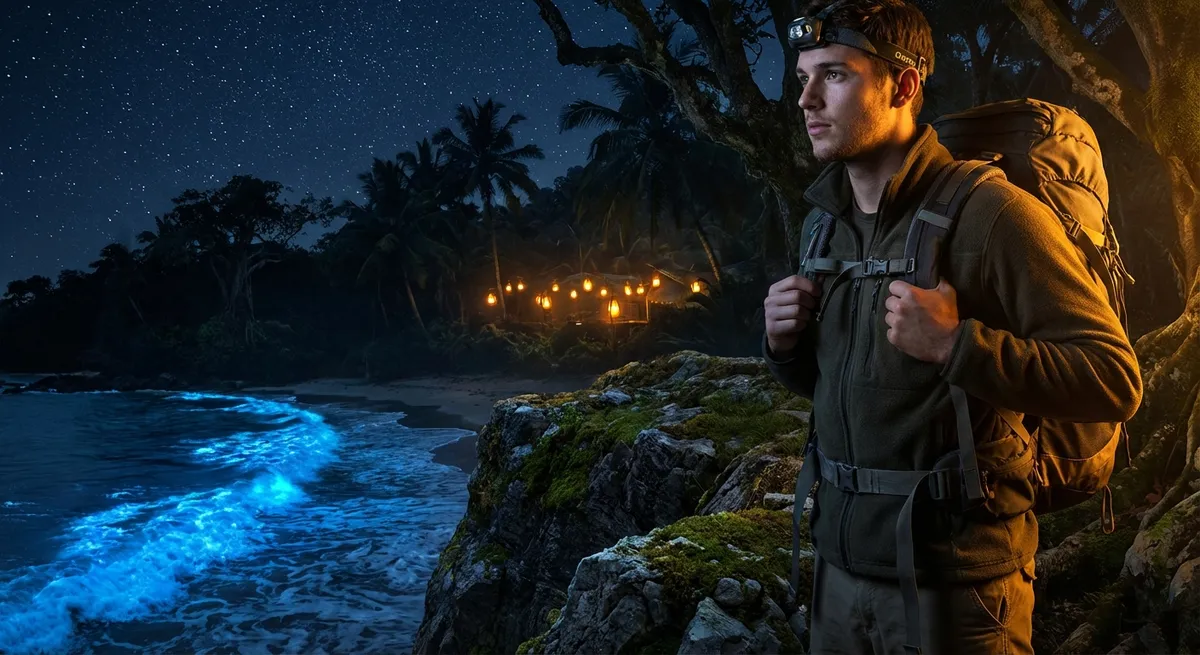
This isn’t about nightlife in the “bars and clubs” sense (though you’ll find those too). It’s about destinations that transform after dark—where evening becomes the main event, and you feel like you’ve stepped through a secret door the daytime crowd never found.
Below are five after-dark experiences around the world that don’t just add a few extra hours to your itinerary—they flip the script on what a destination can be.
1. Bioluminescent Shores: Walking Where the Ocean Glows
Some coastlines don’t need streetlights; the waves bring their own. In bioluminescent bays and beaches, microscopic organisms called dinoflagellates flash neon blue when disturbed, turning every step, splash, and paddle stroke into electric light.
Imagine kayaking at night in Puerto Rico’s Mosquito Bay: each stroke of your paddle leaves a comet tail of blue, every fish streaks away like a glowing arrow. In parts of Thailand, the Maldives, and Jamaica, the shoreline itself shimmers when waves collapse on the sand. It feels unreal, like the sea stole a piece of the sky and decided to keep it.
Practical moves:
- Go on a moonless night. Too much moonlight will dull the glow—tours often publish “best nights” based on the lunar cycle.
- Skip sunscreen and chemicals before swimming. Protect the fragile marine ecosystem and follow local guidelines; some places now limit swimming to preserve the bay.
- Choose reputable local operators. Look for tours that emphasize conservation and limit group size; these ecosystems are powerful but delicate.
- Bring a dry bag and red-light headlamp. Red light preserves your night vision and doesn’t blow out the magic like a bright white beam will.
For travelers used to checking sights off a list, bioluminescent bays flip the script. There’s nothing to “see” until you move—and suddenly you’re not just an observer, you’re part of the light show.
2. Desert Skies: Sleeping Under a Billion Unfiltered Stars
Cities hide the universe. Deserts reveal it. In places like the Atacama in Chile, the Wadi Rum in Jordan, and dark-sky reserves in the American Southwest, the night sky doesn’t “come out”—it dominates. The Milky Way isn’t a faint streak; it’s a river of light so detailed you’ll start to understand why ancient travelers navigated by it.
Picture this: you’ve finished dinner around a campfire in Wadi Rum, the sandstone cliffs fading into silhouettes. Your guide dims the lanterns, and silence drops with the darkness. Within minutes, the sky sharpens. Constellations you’ve only seen in apps become three-dimensional, and shooting stars feel almost routine.
Practical moves:
- Seek out Dark Sky Parks and Reserves. Places like Utah’s national parks, Chile’s San Pedro de Atacama, and parts of New Zealand protect night skies from light pollution.
- Stay at least one night in the desert. Day trips won’t cut it—you need the middle-of-the-night silence when crowds are gone.
- Layer up. Deserts flip from scorching days to surprisingly cold nights; a light down jacket and beanie can make or break the experience.
- Use stargazing apps sparingly. Download offline maps beforehand, then put your phone away for chunks of time—your eyes need 20–30 minutes to fully adapt to darkness.
A desert night doesn’t just show you stars; it recalibrates your sense of scale. Under that sky, your worries feel appropriately small—and your possibilities suddenly don’t.
3. Midnight Cities: Urban Adventures That Only Start After Sunset
Some cities are good in the daytime. Others are built for the long after. Tokyo’s Shibuya crossings, Hong Kong’s vertical neon canyons, and Istanbul’s late-night ferries prove that urban life doesn’t go to sleep—it just shifts gears.
You might walk across a bridge in Budapest to see the Parliament building glowing like a fairytale castle on the river, then cross back to find ruin bars pulsing inside crumbling courtyards. In Seoul, a 2 a.m. meal in a tiny alleyway restaurant can carry more flavor and energy than a whole day of sightseeing.
Look for the layers:
- Night markets, not just restaurants. In cities like Taipei, Bangkok, and Marrakech, food, fashion, and local life spill into the streets after dark.
- Waterfront walks and night ferries. City skylines from the water—Sydney Harbour, Hong Kong’s Victoria Harbour, or Istanbul’s Bosphorus—turn architecture into light shows.
- Rooftop viewpoints. From Singapore’s Marina Bay Sands to local hillside bars in Lisbon, night views turn maps into living constellations of city light.
- Trust your instincts and be street-smart. Stick to well-lit areas, keep valuables zipped and close, and use licensed taxis or reputable ride-hailing apps.
- Join a night walking tour. Local guides can show you neighborhoods that feel intimidating solo—but unforgettable in good company.
- Time your photos, then put the camera down. Get your shots early, then let yourself sink into the rhythm of the nightlife instead of chasing the next angle.
Practical moves:
In the right city, the night isn’t just an extension of the day—it’s a completely different destination, one that invites you to keep saying “just one more block” long after you meant to head home.
4. Volcano Rims and Moonlit Craters: Chasing Fire in the Dark
Some landscapes feel otherworldly; volcanic ones are something else entirely. Hike a volcano at night and the line between Earth and space blurs. You’re walking up into the sky, headlamps bobbing, the world below falling silent while the horizon slowly invents a new day.
In Indonesia, pre-dawn treks to Mount Batur or Mount Bromo reward you with sunrise above a sea of clouds, crater rims glowing in the early light. On islands like Hawaiʻi’s Big Island, you may (depending on volcanic activity and safety restrictions) catch the red glow of lava fields or steam plumes under a star-filled sky, a reminder that the ground beneath your feet is very much alive.
Practical moves:
- Check current conditions and restrictions. Volcano access changes quickly based on safety and activity; always follow local authorities and park guidelines.
- Start in the dark, finish at dawn. Night hikes up, sunrise descents down—that’s when the landscape reveals everything it was hiding behind the darkness.
- Pack for extremes. Headlamp with extra batteries, sturdy shoes, layers for wind and chill, and enough water. Volcanic terrain can be rough and exposed.
- Go with certified local guides. They know the latest safety updates, best routes, and vantage points; on active volcanoes, that knowledge can be critical.
Standing on a crater rim as the sky lightens, you feel like you’ve climbed beyond your usual limits—not just of altitude, but of what you thought you could handle. Night makes the climb more intense. Dawn makes the effort worth every step.
5. Polar Nights and Dancing Skies: Stepping Inside the Northern Lights
The aurora borealis doesn’t feel real until you’re standing under it. Photos don’t prepare you for the way the lights move—curtains rippling, arcs bending, green and purple veils appearing, fading, and reappearing in silence.
In Arctic destinations like Tromsø (Norway), Abisko (Sweden), Fairbanks (Alaska), or parts of Iceland and northern Canada, you chase darkness instead of daylight. Winter means long nights, which is exactly what you want. You head out with a thermos of something hot, find a clearing away from light pollution, and then you wait. When the sky finally erupts, everyone around you goes completely quiet.
Practical moves:
- Aim for peak aurora season. Typically between late fall and early spring; local tourism boards list prime months.
- Be flexible with dates and expectations. The aurora is a natural phenomenon; even in top locations, you may need several nights of trying.
- Dress for deep cold. Layered thermal clothing, insulated boots, hand and toe warmers, and something windproof on top. Comfort = patience, and patience = better chances.
- Join a small-group “aurora chase.” Local guides know weather patterns, cloud breaks, and vantage points better than any app.
Northern lights trips turn night into your main playground. Sleep becomes negotiable; you can nap later. When the sky starts to dance, you’ll be grateful you traded a few hours of rest for a memory that refuses to fade.
Conclusion
Daylight is familiar. It’s where the tours operate, the maps make sense, and the photos are easy. But it’s not the whole story.
When you start choosing destinations for what they do after dark—glowing oceans, star-drunk deserts, electric cityscapes, volcanic silhouettes, and skies painted in aurora—you stop traveling just to see things. You start traveling to feel things: the hush of a campfire under a billion stars, the rush of watching your kayak carve light into black water, the chill on your face as green ribbons unfurl overhead.
On your next trip, don’t just ask, “What will I do tomorrow?” Ask, “Where does this place come alive tonight?”
That’s where the real Hop Next moments begin—on the edges of the day, where the world turns its lights down and its magic up.
Sources
- Discover Puerto Rico – Bioluminescent Bays – Official guide to Puerto Rico’s bioluminescent bays, including Mosquito Bay and conservation tips
- International Dark-Sky Association – Dark Sky Places – Directory of certified dark-sky parks and reserves around the world for prime stargazing
- National Park Service – Stargazing in U.S. Parks – Practical advice and featured destinations for stargazing in U.S. national parks
- U.S. Geological Survey – Volcano Hazards Program – Up-to-date information on volcanic activity and safety considerations in volcanic regions
- Norwegian Meteorological Institute – Aurora Forecast – Scientific aurora forecast and guidance for Northern Lights viewing in Scandinavia and beyond