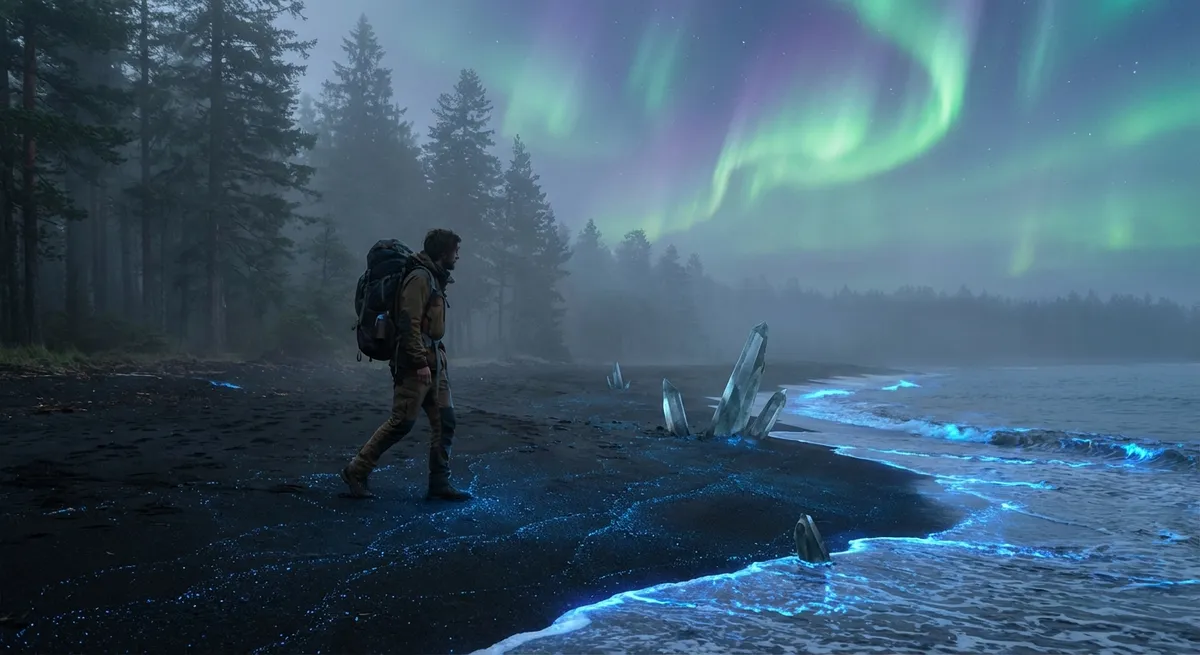
This is your invitation to chase the edges of the familiar and step into landscapes that feel almost impossible. Each of these destinations offers one powerful, thrilling promise: you won’t go home the same.
1. Bioluminescent Shores: Walking Through Liquid Starlight
Imagine wading into the ocean at night and watching the water ignite with electric-blue sparks around your legs. Every step, every splash, every wave lights up—a private galaxy swirling at your feet.
Bioluminescent bays and beaches, like Mosquito Bay in Puerto Rico or Vaadhoo Island in the Maldives, are where tiny organisms flash with light when disturbed. Standing there in the dark, you realize how wildly alive the planet is, even in the places we call “empty.”
For the most magical experience, aim for moonless nights and still water; bright moonlight can dull the glow. Avoid sunscreen and insect repellent in the water—these can harm fragile marine life. Instead, wear lightweight, long-sleeve clothing onshore and enter the water slowly and mindfully. Skip motorized boats and opt for clear-bottom kayaks or paddleboards run by eco-conscious operators who limit group size and protect the bay.
If you want to share this moment online, ditch the flash and use long-exposure settings on your camera or phone. But don’t forget to put it down, too. There’s a point where you stop trying to capture the magic and let it capture you.
2. High-Altitude Cities That Teach You a New Pace
Some destinations introduce you to new foods or languages. High-altitude cities introduce you to a new version of your own body.
Places like La Paz in Bolivia, Lhasa in Tibet, or Cusco in Peru sit in the sky, often above 3,000 meters (9,800 feet). The air is thinner, the light is sharper, and your usual walking pace suddenly feels ambitious. You’re forced into a slower rhythm, one breath at a time. It’s humbling, and strangely liberating.
The key here is respect—both for your limits and for the communities who call these places home. Give yourself two days to acclimatize before diving into intense hikes or long sightseeing marathons. Drink more water than usual, avoid heavy alcohol, and keep your first meals simple. Listen to locals: coca tea in the Andes, easy walks instead of long climbs, and resting when your body asks.
High-altitude cities reward patience. As you slow down, you notice everything: the sound of street vendors, the swirl of markets, the way clouds drift at eye level. Your adventure here isn’t about how much ground you cover; it’s about how deeply you let the place in.
3. Desert Silence That Feels Almost Otherworldly
If forests feel alive with sound, true desert feels like a different planet—wide horizons, endless sky, and a silence so complete it becomes its own kind of music.
In deserts like Wadi Rum in Jordan, the Atacama in Chile, or Namibia’s Namib Desert, the scale warps your sense of distance. Mountains look close, then take hours to reach. Sand dunes shape-shift in the wind. At night, the sky turns into a deep velvet dome punctured by stars so sharp you feel you could lean back and fall into them.
This is the kind of destination that invites you to strip life down to essentials. Pack light, but smart: sun coverage (wide-brim hat, sunglasses, long sleeves), more water than you think you’ll need, and layers for surprisingly cold nights. Book with local guides—Bedouin in Jordan, Indigenous communities in the Atacama—who know the land, the weather, and the stories woven into every rock.
Desert travel teaches a special kind of adventure: not chasing constant stimulation, but letting vastness slow your thoughts until you finally hear what’s underneath the noise of daily life. Share the sunrise, the starry sky, the red-rock silhouettes—but keep a few moments just for you and the wind.
4. Hidden Thermal Realms: Where the Earth Breathes Steam
Hot springs feel like the planet’s heartbeat rising to the surface. The first time you soak in a natural pool surrounded by snow, jungle, or mountains, you understand how strange and generous the Earth can be.
Destinations like Iceland’s geothermal fields, Japan’s onsen towns, and Costa Rica’s volcanic hot springs are more than spa experiences; they’re doorways into geology you can feel on your skin. You sit in steaming water as cold air brushes your face, and suddenly you’re aware that just beneath the surface, the planet is boiling, shifting, alive.
Respect is non-negotiable here. In places like Japan, learn onsen etiquette: wash thoroughly before entering, keep voices low, and follow clothing norms (often no swimsuits in traditional baths). In wild springs, follow local advice about safe temperatures, avoid entering restricted areas, and never use soaps or chemicals.
Plan your visits for early morning or later in the evening to avoid crowds and get that dreamlike atmosphere where rising steam catches the soft light. This is adventure in its most elemental form—fire and water meeting beneath your feet, reminding you that comfort and raw power can coexist.
5. Ancient Pathways That Rewire Your Sense of Time
Some destinations don’t just show you history—they let you walk straight through it. Pilgrimage trails and ancient routes have been shaped by millions of footsteps across centuries, and when you follow them, you’re never really walking alone.
Routes like Spain’s Camino de Santiago, Japan’s Kumano Kodo, or sections of the Silk Road connect villages, shrines, coastlines, and mountain passes into threads of living story. You fall into the rhythm of walking: step, breath, view, repeat. Strangers become trail companions. Small details become huge: a simple meal, a bed at the end of the day, a conversation at a roadside café.
To make the most of these journeys, pack for long-term comfort, not just aesthetics. Lightweight, broken-in footwear matters more than any trendy gear. Learn a few phrases in the local language—enough to say thank you, ask for directions, and greet people respectfully. Travel with curiosity rather than a checklist; if a local suggests a detour to a viewpoint or a family-run inn, consider saying yes.
Sharing these routes online, focus not just on the big landmarks but on the quiet in-between moments: the empty road at dawn, the shoes left drying outside a hostel, the handwritten note on a café wall. That’s where the real magic of these paths lives.
Conclusion
The world isn’t just a collection of places—it’s a collection of thresholds. Bioluminescent bays, sky-high cities, vast deserts, geothermal wonderlands, and ancient paths all ask the same question: how willing are you to let a place rearrange you?
You don’t have to wait for the “perfect time” to start exploring differently. Start with one destination that feels just a little beyond your usual choices. Follow the glow, the altitude, the silence, the steam, or the old stone paths. Pack your curiosity, travel lightly, and let each new landscape stretch the borders of what you thought your life could feel like.
Your next world isn’t on another planet. It’s already out there, waiting for you to step across the line.
Sources
- National Park Service – Night Skies and Stargazing - Overview of dark-sky experiences and why certain remote destinations offer exceptional night views
- NASA Earth Observatory – Bioluminescence in the Ocean - Explains the science behind glowing shores and bioluminescent organisms
- Centers for Disease Control and Prevention – High-Altitude Travel & Altitude Illness - Practical guidance on safely visiting high-altitude destinations
- Iceland Travel – Geothermal Pools & Hot Springs - Official information on geothermal bathing culture and locations in Iceland
- Japan National Tourism Organization – Pilgrimage Routes - Details on historic walking routes like the Kumano Kodo and how travelers can experience them