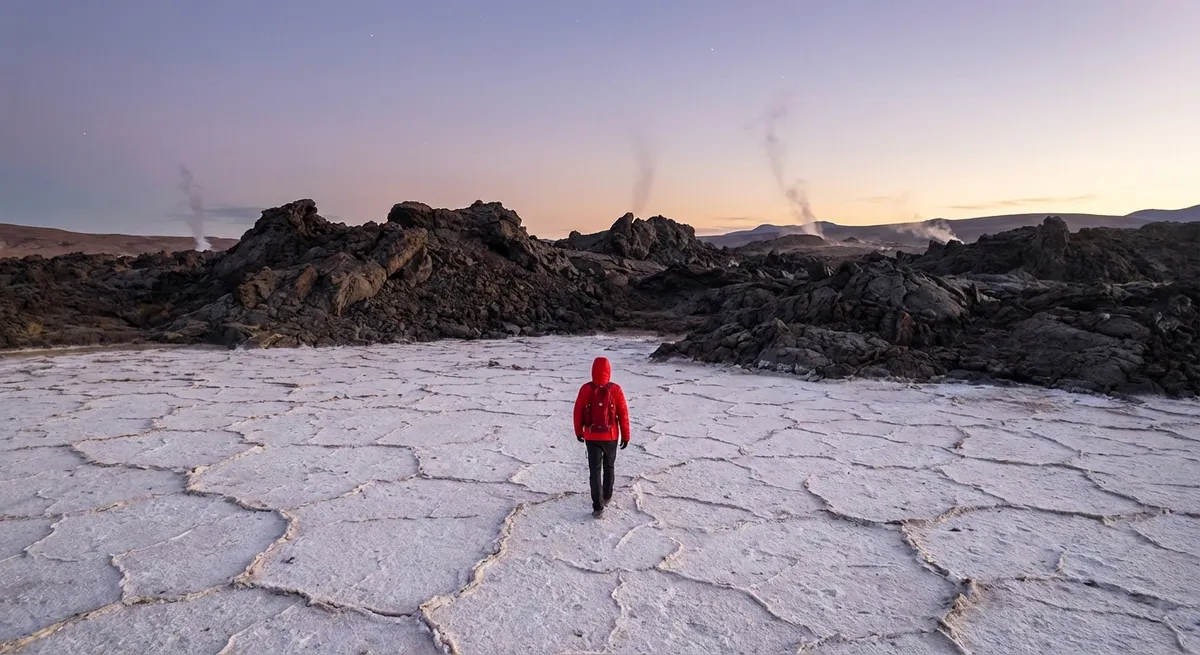
Below are five wildly different corners of the planet that feel alien in the best way—and exactly how to experience them without just staring from behind a tour bus window.
Walk on Mars in Wadi Rum, Jordan
In southern Jordan, the sandstone and granite desert of Wadi Rum looks so otherworldly that filmmakers use it as a stand-in for Mars. The horizon is lined with towering red cliffs, the sand glows like embers at sunset, and the night sky explodes with stars so bright you’ll question every light-polluted city you’ve ever known.
Spend the day bouncing across the desert in a 4x4 with a local Bedouin guide, stopping to scramble up dunes, crawl into ancient rock inscriptions, and sip sweet tea in the shade of rock arches. At dusk, trade the engine’s roar for silence: hike a short ridge to watch the sun melt into the copper landscape, then ride a camel back to camp.
Stay in a Bedouin camp or a bubble-style desert pod where the Milky Way becomes your ceiling. Bring layers—desert nights bite—and a headlamp so you can wander without fumbling. Skip the rushed day trip if you can; Wadi Rum reveals its real magic after the tour groups leave and the desert hums with quiet.
Captivating point: You can sleep “on Mars,” under a sky so clear you’ll see satellites move—and realize how small and lucky you are.
Dive Into a Living Kaleidoscope in Raja Ampat, Indonesia
Raja Ampat, a remote archipelago off West Papua, feels like a secret scattered across the sea. From above, the islands look like emeralds tossed into turquoise water. Below the surface, it’s a riot of color: coral gardens, swirling schools of fish, manta rays gliding like underwater spacecraft.
Getting there takes effort—usually flights to Sorong, then a boat—but that thin layer of difficulty is a blessing. It keeps the crowds away and the reefs some of the richest on Earth. Base yourself on a homestay over the water, where you can roll out of bed, walk a few steps, and drop your mask straight into an aquarium come to life.
Prioritize dawn snorkeling sessions before the sun gets intense and the boats start to buzz. Learn the basic reef etiquette—no touching, no chasing—and watch the ecosystem unfold around you: clownfish guarding their anemones, reef sharks cruising at the edge of visibility, tiny nudibranchs glowing like neon art.
Captivating point: You’re not just visiting a destination—you’re swimming inside one of the most biodiverse marine realms on the planet, a living reminder that Earth is still full of undiscovered magic.
Chase the Northern Lights in Tromsø, Norway
Tromsø sits far above the Arctic Circle, where winter nights stretch long and the sky sometimes decides to dance. The aurora borealis isn’t guaranteed, but when it appears, it feels like the atmosphere is breathing—curtains of green, pink, and violet rippling overhead.
Base yourself in Tromsø, a small city with a big adventure heart. During the day, ride cable cars into surrounding peaks, snowshoe through hushed forests, or try dog sledding across white horizons. At night, join an aurora chase tour; guides monitor weather and solar activity, then drive you to clear-sky pockets, sometimes all the way into Finland.
Dress like you’re preparing for the moon: thermal layers, windproof outer shell, warm boots, hand warmers. Bring a tripod and learn a few simple camera settings in advance (high ISO, long exposure) so you’re not fumbling in the cold when the sky erupts. If the lights don’t appear, you still get the surreal experience of standing under an Arctic sky so dark it feels infinite.
Captivating point: One moment, the sky is still. The next, it peels open in luminous waves that make grown adults cheer and cry in the snow.
Hike the Rainbow Mountains of Vinicunca, Peru
High in the Peruvian Andes, Vinicunca—often called Rainbow Mountain—looks like someone spilled a box of chalk pastels across the peaks. Bands of rusty red, mustard yellow, green, and lavender stripe the slopes, created by layered minerals exposed by time and erosion.
Reaching the viewpoint is an adventure in altitude as much as distance. The trailhead starts above 4,000 meters (13,000 feet), and the climb to around 5,000 meters (16,400 feet) will test your lungs. Start early to dodge the crowds and harsh midday sun. Take it slow, drink coca tea, and snack often—this is a marathon in thin air, not a sprint.
As you crest the final ridge, the painted mountains swing into view, and the effort falls away in a rush of color and thin, cold wind. You’ll share the moment with llamas, local Quechua vendors selling hot soup, and other hikers wrapped in their own astonishment. Consider spending a few days acclimatizing in Cusco or the Sacred Valley first; your body will thank you.
Captivating point: In a single panoramic sweep, you see proof that the planet is an artist—and you’re standing in the gallery.
Walk on Glass at Zhangjiajie, China
The sandstone pillars of Zhangjiajie National Forest Park in China inspired the floating mountains of the movie “Avatar,” and standing among them feels like stepping into CGI that somehow became real. Mist curls around stone spires, forests cling to impossible cliffs, and glass walkways cling even tighter.
Take the cable car up Tianmen Mountain, then test your courage on the glass skywalks bolted to sheer cliff faces. You’ll know they’re safe, but your legs might disagree the moment you look through the transparent floor and see the valley yawning far below. It’s thrilling, humbling, and slightly terrifying in the most exhilarating way.
Beyond the glass, hike forest trails that weave through these vertical worlds, ride the Bailong Elevator (one of the tallest outdoor elevators on Earth) for sweeping views, and wander quiet side paths when you need a break from the crowds. Good shoes and patience are essential; this is a popular destination, but early starts and shoulder seasons buy you pockets of near-solitude.
Captivating point: You literally walk in the air between stone giants, somewhere between fear and flight, and realize how small your comfort zone used to be.
Conclusion
You don’t have to leave Earth to feel like you’ve left the familiar solar system behind. Deserts that mimic Mars, seas that blaze with life, skies that write in light, mountains painted by minerals, and cliffs laced with glass—all of them are invitations.
Not just to take a vacation, but to stretch who you are: to test your courage on a skywalk, your patience under Arctic stars, your lungs in thin Andean air, your curiosity beneath tropical waves, your sense of wonder in a red desert silence.
The map is still full of places that feel impossible until you stand there. The next step is simple, and it’s yours: choose one that tugs at you, put a date on it, and let your orbit shift.
Sources
- UNESCO World Heritage Centre – Wadi Rum Protected Area - Background on Wadi Rum’s landscape, culture, and World Heritage status
- Conservation International – Raja Ampat: A Global Center of Marine Biodiversity - Overview of Raja Ampat’s ecology and significance for marine conservation
- Norwegian Meteorological Institute – Aurora Forecast - Real-time and short-term forecasts for the northern lights in Norway
- PromPerú – Vinicunca (Rainbow Mountain) Travel Information - Official guidance on visiting Rainbow Mountain, including altitude tips
- UNESCO Global Geoparks – Zhangjiajie UNESCO Global Geopark - Details on Zhangjiajie’s geology and landscape features