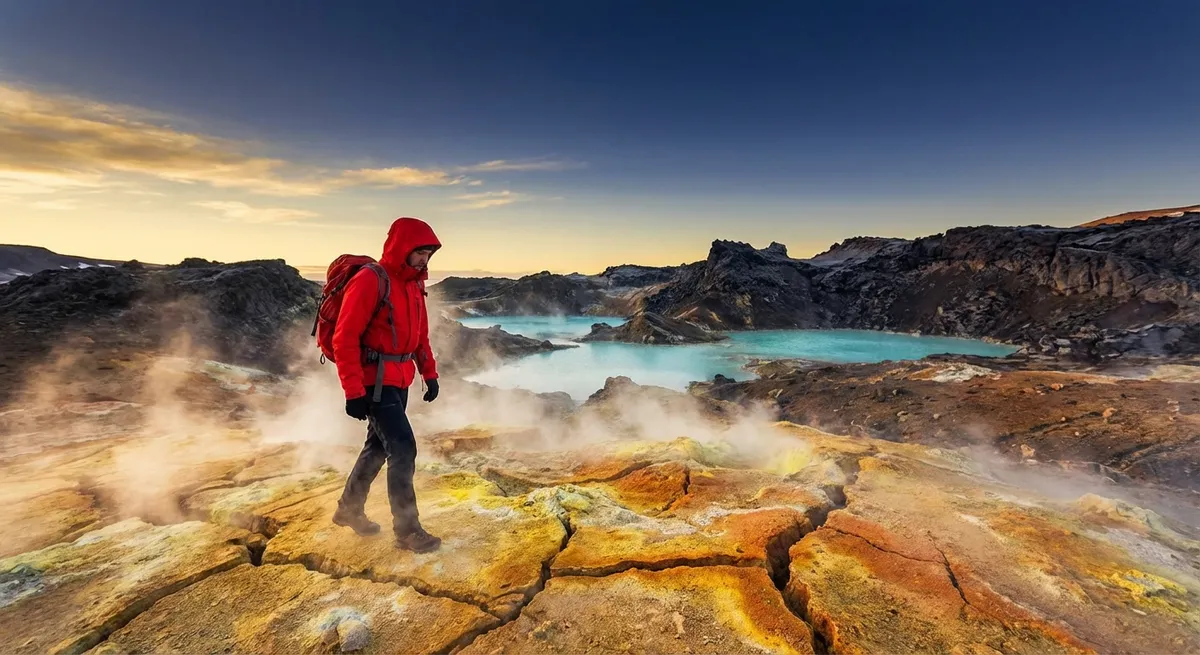
This isn’t about ticking countries off a list. It’s about standing somewhere so extraordinary that you have to remind yourself: this is still Earth, and you are really here. Ready to step into the surreal?
1. Iceland’s Elemental North: Where Fire, Ice, and Sky Collide
Follow the ash-black roads of northern Iceland and the world you know starts to slip away. Steam hisses from the ground, neon blue pools glow in the cold, and jagged lava fields stretch toward distant snow‑draped peaks. It feels like wandering across the surface of a newly formed planet still cooling off.
Base yourself around Akureyri or the Lake Mývatn area if you want that “edge of the Earth” feeling with just enough comfort. Soak in geothermally heated pools while snowflakes melt on your shoulders, then chase the aurora borealis into the night, watching green ribbons pulse and twist across the sky. During summer, the sun barely dips below the horizon; during winter, the darkness turns every light into an event.
Practical move: rent a car and keep your days flexible. Weather in Iceland is a character of its own—wild, moody, and unpredictable. Pack layers, waterproof boots, and offline maps. The more prepared you are, the freer you’ll feel to follow the steam vents, waterfalls, and cratered landscapes wherever they lead.
2. Jordan’s Wadi Rum: Sleeping Under Galaxies in the Red Desert
Walk into Wadi Rum and you could swear you’ve accidentally teleported to Mars. Sand shifts from soft amber to deep red, giant sandstone cliffs erupt straight from the desert floor, and silence presses in so deep it’s almost a sound of its own. This is a place that strips travel down to its bones: horizon, rock, sky, and you.
Stay in a Bedouin desert camp tucked between rock formations and watch the stars switch on one by one. At night, the sky is so dense with galaxies that the constellations feel like old stories being whispered straight into your eyes. By day, ride in the back of a 4x4, climb wind‑carved rock bridges, or simply walk until the world turns into color and shape instead of thought.
Practical move: go with a locally run camp. You’ll support Bedouin communities and get stories and perspectives you’ll never find on a hotel website. Dress for extremes—hot days, cold nights—and bring a scarf to shield from sun and sand. Most importantly, don’t over-schedule. Wadi Rum is best experienced in the empty moments: watching a cliff turn gold at sunset, or feeling the air still between desert winds.
3. Japan’s Yakushima: Island of Ancient Forests and Living Mist
If you’ve ever wanted to step into a living fantasy forest, Yakushima off Japan’s southern coast feels like a portal. Trails disappear into dense green, moss coats everything like velvet, and rivers slice through tangled roots and stone. Mist curls between ancient cedar trees—some over 1,000 years old—like the island is quietly breathing.
Hiking here is less about conquering a summit and more about submitting to the pace of the forest. The ground is soft with centuries of fallen needles, the air holds the scent of rain even on sunny days, and tiny details—fern fronds, droplets, insects—steal your attention from the big picture. It’s disorienting in the best way: your brain, tuned to cities and screens, slowly gives up and lets your senses lead.
Practical move: stay at least two to three nights to give yourself time to adjust to the island’s rhythm. Pack serious rain gear; Yakushima is famous for its frequent showers, which are exactly what make the place so lush and otherworldly. Respect trail rules and stay on marked paths—these ecosystems are ancient and fragile. Bring a small notebook if you can; it’s the kind of place that pulls thoughts and reflections out of you without asking.
4. Bolivia’s Salar de Uyuni: Walking on the World’s Giant Mirror
At Salar de Uyuni, the horizon loses its job description. When a thin layer of rain covers the salt flat, sky and earth melt into one infinite reflection. Stand there and it feels like you’re floating between two heavens, with clouds beneath your feet and the world unhooked from gravity.
In the dry season, the ground cracks into perfect geometric patterns, a sprawling white jigsaw stretching as far as you can see. Stay a night in a salt hotel—yes, built from salt blocks—then wake before dawn to watch the first blush of light slide across a surface so bright it feels like illumination instead of scenery. Add a visit to the nearby high-altitude lagoons, where flamingos wade through ruby and turquoise waters framed by snow‑capped volcanoes.
Practical move: go with a reputable local operator and research altitude sickness before you arrive. Many tours travel at high elevations, and your body needs time and hydration to adjust. Bring sunglasses and strong sunscreen; the reflection off the salt is no joke. For photographers, pack extra batteries and memory cards—you’ll use more than you think when every direction looks surreal.
5. New Zealand’s Fiordland: Sailing the Edges of the Possible
Sail into New Zealand’s Fiordland—especially Milford or Doubtful Sound—and the world narrows to water, cliffs, and sky. Sheer rock walls rise straight from black depths, carved by ancient glaciers into cathedral-like shapes. Waterfalls spill down in long silver threads, catching the light before vanishing into mist. When low clouds roll in, it’s like traveling through a dream that hasn’t fully decided its form yet.
The area feels less like a destination and more like a living, breathing presence. Dolphins race the boats, penguins pop up like surprised punctuation marks, and sometimes the crew will cut the engines and ask everyone to stand in silence. In that moment you hear the true soundtrack of the place: distant cascades, gull calls, and the soft push of water against rock.
Practical move: visit outside peak midday tours if you can—early morning or late afternoon departures feel more intimate. Pack waterproof layers even on “clear” days; weather can turn on a dime, and the rain only makes the waterfalls more ferocious. Consider pairing a cruise with a short hike or kayak outing so you can experience the scale of the fjords from both water level and above.
Conclusion
You don’t have to leave the planet to feel like you’ve stepped into another world. Our own Earth is already wild, strange, and astonishing enough to challenge every assumption you carry about what travel “should” look like. The real adventure isn’t just reaching these places—it’s letting them rewrite the way you see everything else.
Pick one destination that feels a little out of your comfort zone, one that makes you say, “Is that even real?” Then start planning. Because the moment you stand in a red desert under a billion stars, or on a salt flat that turns the sky upside down, you’ll realize something powerful: the world is far more extraordinary than you’ve been led to believe—and so are you.
Sources
- Visit Iceland – Official Travel Guide - Practical information and highlights for exploring North Iceland
- Jordan Tourism Board – Wadi Rum - Overview, history, and travel tips for visiting Wadi Rum
- Japan National Tourism Organization – Yakushima - Official guidance on Yakushima’s nature, access, and hiking options
- Bolivia Travel – Salar de Uyuni - Detailed information on visiting the world’s largest salt flat
- New Zealand Department of Conservation – Fiordland National Park - Official conservation, safety, and visitor guidance for Fiordland