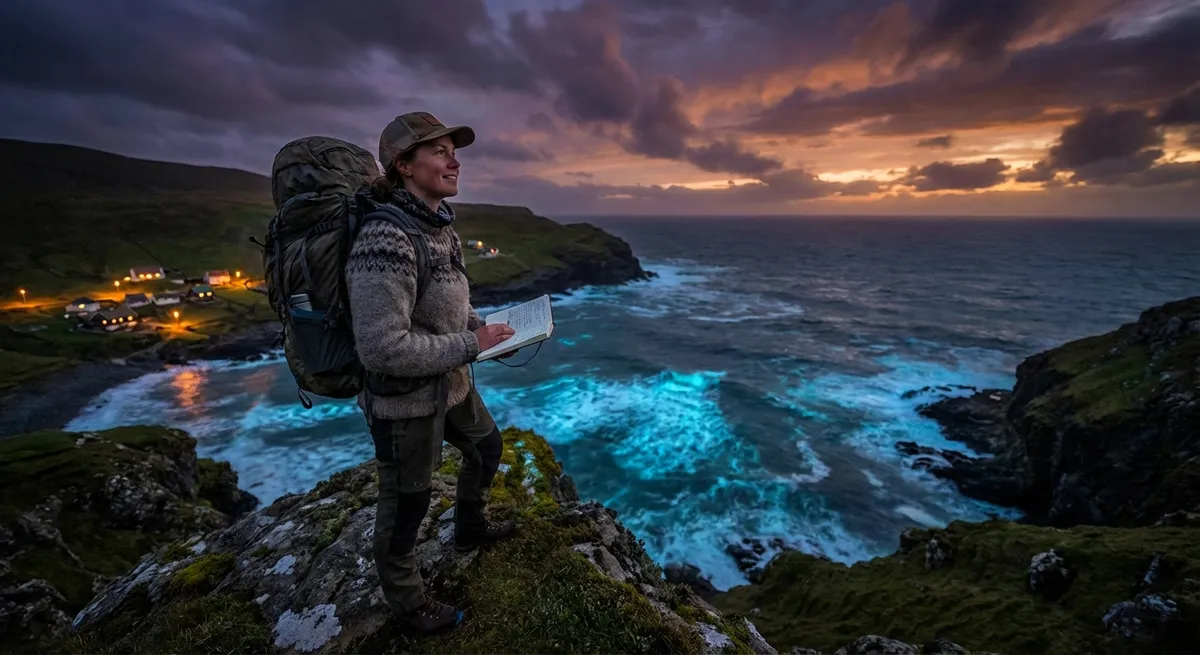
These five powerful destination “types” aren’t about specific cities on a list. They’re about the kinds of places that wake something up in you—and how to find your own version of each, anywhere on the globe.
1. The Edge-of-the-Map Place: Where the World Feels Wild Again
There’s a certain electricity in standing somewhere that feels like the end of the road: wind tearing past your jacket, horizon unbroken, your phone slipping into “no service.” Edge-of-the-map destinations aren’t necessarily remote corners of the Arctic—they’re any place where nature is clearly in charge and you are clearly very small.
Think cliff-lined coastlines where waves slam against black rock, high plateaus where the sky feels close enough to lean on, or desert valleys where the night is so dark you can hear the stars. These places reset your inner noise level. The questions that felt urgent back home suddenly feel … smaller. You’re reminded that the world was wild long before your inbox became full.
How to make the most of it:
- Go when it’s quiet: sunrise, sunset, shoulder season, or midweek.
- Walk until the parking lot disappears from view—distance changes everything.
- Pack layers and real shoes; discomfort distracts from awe.
- Let yourself just stand there for a while without photos. Then take one shot that actually means something to you.
Find your “edge of the map” in a windswept headland, a high alpine pass, a rugged coastline trail, or a lonely lava field. The point isn’t how far you go from home; it’s how far you step from your comfort zone.
2. The City That Never Sleeps (But Teaches You to Wander)
Some cities hum. Others roar. The world’s great hyper-energetic cities—neon skylines, late-night food stalls, streets that never seem to empty—can feel like drinking straight from the tap of life. They’re overwhelming at first, but in the best ones, that chaos turns into a kind of music once you learn how to listen.
In these places, it’s not just the landmarks; it’s the way a side street can surprise you with a hole‑in‑the‑wall café that becomes your new favorite spot, or how a late-night market teaches you more about a culture in one hour than a stack of guidebooks ever could. You learn to drift, to follow your curiosity, to trust your feet.
How to make the most of it:
- Pick one neighborhood per day and explore it deeply instead of racing everywhere.
- Use public transit at least once—it’s the bloodstream of the city.
- Eat where the line of locals is longest, not where the sign is biggest.
- Give yourself one “lost hour” daily with no map and no agenda.
Your transformative city might be a megacity in Asia, a historic capital in Europe, or a rising metropolis in Africa or South America. What matters is the feeling of being plugged into a living, breathing organism that keeps moving long after you go to bed.
3. The Culture-Shift Destination: Where Your Assumptions Don’t Work
Every traveler eventually finds that one place where nothing is quite how they expected—the language flows differently, time moves at another speed, and even simple interactions challenge your assumptions. At first it can feel disorienting. Stay with it; this is where real growth begins.
In a true culture-shift destination, you’ll have moments where your “common sense” simply doesn’t apply. Maybe everything closes in the afternoon for a long meal and a nap. Maybe people bargain for items you’d never dream of negotiating over. Maybe hospitality is so important that strangers insist you come in for tea.
How to make the most of it:
- Learn 10 local words or phrases before you go—and use them constantly.
- Watch how locals greet, eat, and queue; mirror their rhythm instead of imposing yours.
- Say yes (safely) to invitations: a family dinner, a village festival, a neighborhood game.
- Visit a market or public square and just sit for an hour, observing life unfold.
You might initially feel like you stand out, but as you listen more and judge less, something flips: you stop comparing and start appreciating. That’s when travel turns into a conversation instead of a performance.
4. The Slow-Clock Haven: Where Time Stretches Out Again
Not every defining destination is loud or dramatic. Some are quiet places where nothing “important” seems to happen—and that’s exactly why they matter. These are the villages, islands, mountain towns, and lakeside communities where days are marked by simple rituals: morning coffee on the same bench, bells from a distant church, fishermen returning at dusk.
Here, your biggest decisions become: swim or read? Wander the lane or nap under a tree? Yet beneath the simplicity, something profound happens—you begin to notice details again. The smell of bread from a nearby bakery. The way the mountains change color through the day. Children turning a dusty alley into a soccer pitch.
How to make the most of it:
- Stay at least three nights; the magic rarely shows up on the first day.
- Rent a bike or simply walk everywhere—no taxis, no rush.
- Choose one local café or stall and become a “regular” for your short stay.
- Leave whole chunks of your day unscheduled; boredom can be a doorway, not a problem.
These slow-clock destinations quietly recalibrate you. When you eventually leave, you’ll feel a small tug when your schedule fills up again—proof that a different pace is possible, because you’ve lived it.
5. The Challenge Destination: Where You Discover What You Can Do
Some trips ask nothing of you. Challenge destinations demand something—and give something bigger in return. This might be a long-distance trek, a high-altitude village, a cycling route across a region, a surf town with big waves, or a road trip across unforgiving terrain.
Here, the views are only half the story. The other half is internal: the moment you realize you can hike one more hour, that you did navigate a foreign bus system, that you have more resilience than you thought. Sweat, sore muscles, and logistics become part of the legend you’re quietly writing about yourself.
How to make the most of it:
- Train a little before you go—future you will be grateful.
- Start with a challenge that stretches you, not one that breaks you.
- Build in rest days; recovery is part of the experience, not a sign of weakness.
- Celebrate small milestones: the first summit, the first successful negotiation, the first night you handle everything solo.
When you think back later, it won’t just be the mountain pass or the plunging canyon you remember. It’ll be the moment you realized: “I didn’t think I could do this—and I did.”
Conclusion
The destinations that stay with you longest are rarely the ones you visited because a list told you to. They’re the places that met you exactly where you were—and then quietly nudged you into becoming a fuller version of yourself.
As you sketch out your next adventure, don’t just ask, “Where should I go?” Ask, “What do I want to feel? What do I want to discover—about the world, and about me?”
Then choose an edge-of-the-map wild, a restless city, a culture-shift surprise, a slow-clock haven, or a challenge that scares you a little. Somewhere out there, a place is waiting not just to be seen, but to meet you halfway and send you home changed.
Sources
- UN World Tourism Organization – Tourism Highlights – Global tourism data and trends that help understand how travelers are exploring different types of destinations.
- National Geographic Travel – In-depth features on wild places, cultural encounters, and transformative journeys around the world.
- Lonely Planet – Travel Inspiration – Practical guides and destination stories that explore cities, remote regions, and cultural experiences.
- U.S. National Park Service – Find a Park – Official information on protected wild areas and how to experience them responsibly.
- Harvard Business Review – How Travel Affects Creativity – Research-based insight into how exposure to new places and cultures can change thinking and personal growth.