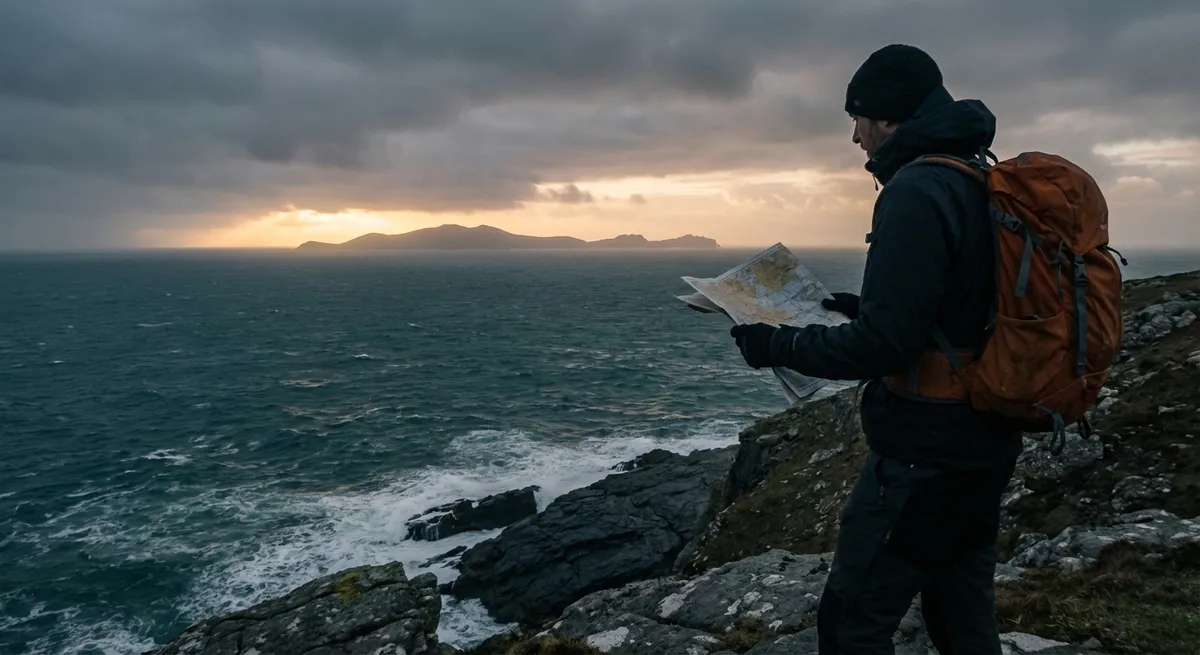
Below are five adventure sparks—each one a different door you can walk through. Mix them, adapt them, and let them pull you toward a version of you that feels more alive than ever.
1. Follow the First Light: Sunrises in Wild Places
There’s a reason sunrise feels different when you’ve hiked in the dark to meet it. It’s not just the colors—pink smeared across clouds, mountains etched in blue—it’s the quiet defiance of choosing to wake up for something, not just to something.
Pick a wild vantage point: a coastal cliff, a desert dune, a forest lookout, a hill outside a small town. Start in the dark with a headlamp and a thermos of something hot. As you move, feel your world shrinking to the crunch of your footsteps and the circle of your light. Then, just before dawn, kill the lamp, sit, and let the sky do the talking.
Practical advice:
- Scout your route the day before so you’re not guessing in the dark.
- Check sunrise time and weather; pack an extra layer—pre-dawn cold cuts deep.
- Keep your backpack light: water, snacks, a basic first-aid kit, and a backup power bank.
What this gives you isn’t just a view. It’s proof you can start your day on your own terms, anywhere on the planet you choose.
2. Let Water Rewrite the Story: Rivers, Coasts, and Hidden Coves
Adventure feels different when there’s a current under you. Rivers, lakes, and coastlines turn still photographs into moving stories—eddies, waves, reflections shifting with every second.
Rent a kayak and trace the edge of a fjord, hidden coves, or a jungle river buzzing with life. Try paddleboarding at sunrise in a quiet bay or night kayaking where bioluminescent plankton flicker like stars beneath your board. Even a calm city canal can become an adventure route when you see it from water level.
Practical advice:
- Always wear a life jacket, even if you’re a strong swimmer. Conditions change fast.
- Learn basic paddling strokes and how to read water: avoid obvious hazards, strong currents, and restricted areas.
- Start with guided tours if you’re new—local experts know the safe spots and secret corners.
Water adventures peel away your usual landmarks. Without city noise and traffic, you’re left with wind, rhythm, and your own strength pulling you toward the next bend.
3. Step into the Unknown City: Urban Exploration with Purpose
Adventure doesn’t demand mountains; it demands curiosity. A city you’ve never walked through—especially one where you don’t speak the language—can feel just as wild as any trail.
Instead of rushing through the “top sights,” pick a theme and build your own route. Street art alleys. Old markets. Artisan workshops. Rooftop viewpoints. Wandering with purpose turns every corner into a potential story.
Practical advice:
- Start in daylight and mark your accommodation on offline maps before you head out.
- Learn a few key phrases: “hello,” “please,” “thank you,” “excuse me,” and “do you recommend…?” open more doors than you’d think.
- Visit local markets with respect—ask before taking photos, buy something small, and watch how locals move through the space.
Urban adventure is about texture: layers of music, food smells, faded paint on doors, languages colliding. Let yourself get just lost enough that you need your instincts—and the kindness of strangers—to find home again.
4. Sleep Where the World Is Still Wild: Nights Under Big Skies
The first night you fall asleep under a sky heavy with stars, you realize how small your daily worries really are. A tent on a cliff, a hammock in a jungle lodge, a desert camp miles from the nearest streetlight—night changes everything you think you know about a place.
When darkness falls, sound takes the lead: wind in grass, insects drumming, distant waves, maybe the low howl of something far off. It can be unsettling. That’s the point. It reminds you that the planet is alive, even when you’re not looking.
Practical advice:
- Choose designated campsites or reputable eco-lodges; they protect the environment and keep you safer.
- Pack a reliable headlamp, warm layers, and a dry change of clothes. Night temperatures usually drop more than you expect.
- Learn and follow Leave No Trace principles—your adventure shouldn’t leave scars on the land.
When you unzip your shelter at dawn and the world outside is washed in new light, you’re not just a visitor anymore. You’re part of the landscape’s overnight story.
5. Move Your Body Beyond Routine: Adventures Powered by You
There’s a quiet thrill in realizing distance that once felt impossible is now behind you. Human-powered adventures—cycling between towns, trekking a multi-day trail, long-distance trail running, or ski touring—reconnect you with something primal: the simple act of going far under your own strength.
Imagine tracing a coastline by bicycle, stopping at fishing villages along the way. Or hiking from hut to hut in the mountains, each day ending with tired legs and new faces around a communal table. Your pace slows, but your connection deepens. You notice how the land changes under your feet—or wheels or skis—because you earned every meter of it.
Practical advice:
- Start with realistic distances and build up gradually; adventure should stretch you, not break you.
- Invest in the basics: good footwear, weather-appropriate clothing, and a pack that fits your body.
- Share your route and expected return time with someone you trust, and carry a small kit with water, snacks, and navigation tools.
When your body becomes your vehicle, you stop treating landscapes like backdrops. They become the path, the challenge, and the reward all at once.
Conclusion
Adventure doesn’t ask who you are on paper—job title, age, fitness level, passport stamps. It asks one question: Are you willing to step beyond what’s familiar?
Maybe for you that’s a pre-dawn hike to chase first light. Maybe it’s trusting a kayak in rougher water than you’re used to. Maybe it’s a city where you can’t read a single sign, or a long-distance trek where each step feels like a promise you keep to yourself.
Whatever door you choose, remember: the edge of your map isn’t a line. It’s a suggestion. The world doesn’t stop there—and neither do you.
Sources
- National Park Service – Trip Planning & Safety – Guidance on preparing safely for outdoor adventures in U.S. parks
- Adventure Travel Trade Association – Adventure Travel Trends – Insights into current global adventure travel interests and activities
- Leave No Trace Center for Outdoor Ethics – The seven core principles for minimizing your impact while exploring wild places
- CDC Travelers’ Health – Up-to-date health and safety information for international trips
- American Canoe Association – Paddlesports Safety – Safety tips and best practices for kayaking, canoeing, and paddleboarding