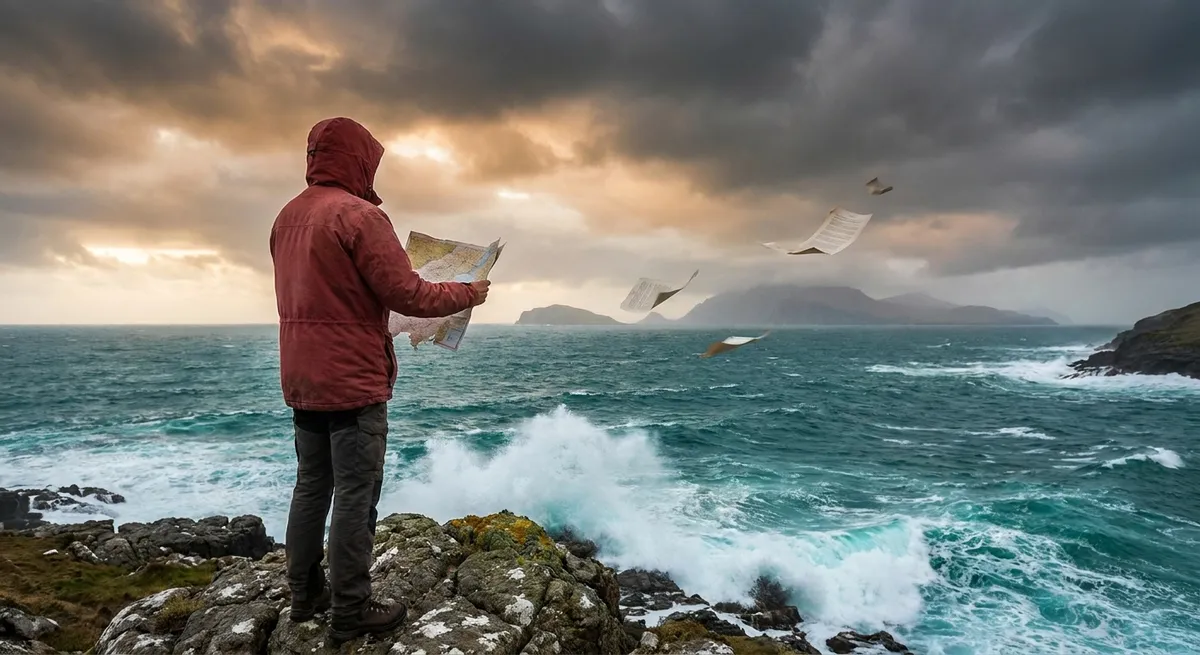
These five adventure ideas aren’t about ticking off brag‑worthy boxes. They’re about carving out experiences that feel intensely alive—and possible—no matter where you are starting from.
1. Follow a Line on the Map and Don’t Stop Until It Changes You
Pick a river. A ridgeline. A coastal road. A train line that cuts across a country. Then decide: you’re going to follow that line as far as you reasonably can—on foot, by bike, by bus, by whatever moves—and see how your world shifts along the way.
Instead of chasing a single destination, you’re chasing a continuous story. Hiking along a river transforms from a day walk into a multi‑day immersion: the water’s width changing, villages giving way to forests, accents and flavors evolving as you move. Biking a coastal road turns into a rolling feast—fresh markets, sea cliffs, tide changes, and tiny towns whose names you’d never find in a guidebook. The line you choose becomes your compass, and your only real rule is to keep going until your legs, your time, or your curiosity says “pause.”
Practical move: Start smaller than you think. Follow a nearby river for two days instead of a month‑long epic. Use offline map apps to track the line, mark wild camps or guesthouses, and note unexpected gems you’ll want to return to.
2. Trade Spectator Seats for Front‑Row Participation
The best adventures don’t put you behind glass; they pull you into the scene. Instead of simply watching a local festival, join a dance circle. Don’t just photograph the market—learn one dish from a vendor, then cook it that night. When you move from observer to participant, travel stops being a performance and becomes a collaboration.
Look for places where skills, traditions, or nature itself invite your hands, feet, and senses into the story. Volunteer on a small farm for a few days and feel what sunrise actually smells like when it hits wet soil. Join a community hike hosted by locals instead of a generic tour. Spend a day learning to navigate by stars, by animal tracks, or by old‑school paper map. You won’t just “see” the destination; you’ll understand how people actually live inside it.
Practical move: Before you arrive anywhere, search for community‑run experiences—co‑ops, cultural centers, local hiking clubs, language exchanges. They’re often cheaper than commercial tours and infinitely richer in human connection.
3. Build a Micro‑Expedition in the Most Familiar Place You Know
Adventure doesn’t have to mean far; it has to mean different. Take the city or region you think you know by heart and flip your script. Plan a 24‑hour micro‑expedition with rules that force you to see it like a stranger.
You might walk across your entire city in a single day, starting at sunrise and ending wherever your feet give out. You might camp (legally) as close to your home as possible—on a nearby hill, a designated campsite, or a friend’s rural backyard—and treat it like a wilderness base camp, complete with star‑spotting and dawn coffee over a camp stove. You could ride the oldest bus or train line from one terminus to the other, getting off at unfamiliar stops, letting curiosity pick your detours.
Practical move: Give your micro‑expedition a theme: “All bridges,” “Highest viewpoints,” “Every public park,” or “All the bakeries I can walk to.” A simple theme turns a random wander into a quest, and a quest is what transforms ordinary streets into an adventure route.
4. Let the Elements Write the Itinerary
Instead of planning around landmarks, plan around the forces of nature themselves: wind, water, cold, heat, altitude, or darkness. Each element unlocks its own style of adventure and its own version of you.
You might chase wind with a beginner’s sailing course or a kite‑surfing lesson. You might surrender to water on a multi‑day kayak journey through calm lakes or sheltered coastline, letting tides and currents set your pace. Cold could draw you to a winter trek, where you learn to layer properly, melt snow for drinking water, and appreciate the absolute stillness of frosted forests. Darkness brings night hikes, bioluminescent bays, meteor showers, and early‑morning summit pushes where sunrise feels like a personal reward.
Practical move: Pick one element and build a long weekend around it. Start with guided or entry‑level experiences run by reputable outfits, then learn the basic safety skills that let you slowly become more independent. Over time, you’re not just collecting adventures—you’re becoming capable of creating your own.
5. Give Your Journey a Mission Bigger Than Your Timeline
The most powerful adventures don’t end when you unpack. They ripple outward—to the people you meet, the environments you touch, and the future you’re shaping. Build a mission into your travels and let that mission guide your choices.
Maybe your mission is “leave every trail better than I found it,” so you pack a trash bag and join local clean‑ups along your route. Maybe it’s to document traditional recipes before they disappear, interviewing elders and asking permission to share their stories. Maybe it’s to travel as low‑carbon as possible, choosing trains and buses over flights whenever feasible and supporting locally owned stays and eateries that keep money in the community.
Practical move: Before you book anything, write a one‑sentence mission for your trip. Use it to filter decisions—transport, activities, gear, even what you post online. A clear mission turns a vacation into a personal expedition with a pulse and a purpose.
Conclusion
Adventures aren’t waiting on distant continents; they’re waiting on the other side of a decision. Follow a single line on the map until it starts to change you. Step out of the audience and into the story. Turn familiar streets into wild territory, let the elements rewrite your plans, and give your journey a mission that outlives your return flight.
You don’t have to be fearless. You only have to be willing: to test your edges, trust your curiosity, and let the world meet you halfway. Somewhere between where you stand and the edge of the map, you’ll find the version of yourself that’s been quietly asking for more.
Sources
- [National Geographic – Adventure Travel](https://www.nationalgeographic.com/adventure) – Inspiring stories and resources on immersive, responsible adventure travel around the world
- [Leave No Trace Center for Outdoor Ethics](https://lnt.org/why/7-principles/) – The core principles for minimizing impact and making adventures more sustainable and respectful
- [U.S. National Park Service – Trip Planning](https://www.nps.gov/subjects/travel/trip-planning.htm) – Practical guidance on preparing safely and thoughtfully for outdoor trips and micro‑expeditions
- [Adventure Travel Trade Association – Adventure Travel Guide](https://www.adventuretravel.biz/research/definitions/) – Definitions and insights into what constitutes adventure travel and how it’s evolving
- [REI Co-op Expert Advice – Outdoor Skills & Safety](https://www.rei.com/learn/expert-advice) – Tutorials and how‑tos on hiking, camping, paddling, and more to build the skills that make independent adventures possible